+91-98111-67809
Insurance for Startup Founders in Noida — Health, Life, Key Man, and D&O Cover

When you leave a corporate job to start a company, several invisible protections vanish simultaneously. The employer health insurance is gone. The group term cover is gone. Any group personal accident or disability protection is gone. The steady income that made paying individual premiums easy may also be gone, at least for the first year.
Meanwhile, your financial exposure actually increases. Personal savings may be invested in the business. You may have taken personal loans or given personal guarantees. Your family's financial security now depends on a startup that has an honest 90-day survival horizon.
India had over 1.4 lakh registered startups as of DPIIT 2025 — per Insurancescape.in's startup insurance guide — making Noida-area founders one of the largest underinsured professional groups in the country.
This is the complete insurance checklist for a startup founder in Noida.
The Four Insurance Layers Every Founder Needs
Layer 1 — Personal Health Insurance (Non-Negotiable)
When you leave an employer, your group health cover ends on your last day. There's no grace period, no continuation option, and no portability mechanism from group to individual health in the standard sense.
Buy a retail health insurance plan within 30 days of leaving your job. Waiting longer means your medical history from those months may need fresh disclosure and could affect underwriting.
Recommended: For a Noida founder aged 28–38 with no significant PED, the right profile plan is HDFC ERGO Optima Secure or Care Supreme — per our detailed plan reviews. Both offer no room rent restriction, no co-payment, and strong claim metrics (HDFC ERGO at 96.71% 3-year CSR per Ditto, July 2026).
Sum insured: At minimum ₹15 lakh individual in Noida's private hospital environment. ₹25 lakh for a family floater covering spouse and children.
GST removal note: As of September 22, 2025, health insurance premiums are GST-free — per Bajaj General's insurance page. All premiums are approximately 18% cheaper than pre-September 2025 quotes.
Self-employed health insurance tax benefit: Premiums paid qualify for Section 80D deduction under the old tax regime (₹25,000 for self and family; additional ₹25,000–₹50,000 for parents).
Layer 2 — Personal Term Insurance (Non-Negotiable)
A founder who dies without term insurance leaves their family and potentially their co-founders in a very specific kind of financial catastrophe — startup equity and business assets may be illiquid or worthless.
Minimum sum assured: 10–12x annual income plus outstanding personal loans/guarantees. For a Noida founder earning ₹20 lakh/year with a ₹50 lakh home loan, the minimum is ₹2.5–3 crore sum assured.
Critical Illness Rider: Essential for self-employed individuals. A CI diagnosis that requires 6–12 months of treatment can destroy business operations if there's no financial buffer. The CI rider's lump sum payout — typically ₹20–50 lakh — provides that buffer while the Waiver of Premium ensures the term cover doesn't lapse during treatment.
Recommended plan: Axis Max Life Smart Term Plan Plus with CI Rider and Waiver of Premium — per Ditto's critical illness guide (June 2026): "Ditto's preferred route is a solid health insurance plan plus a term insurance with a critical illness rider. For example, Axis Max Life Smart Term Plan Plus offers a ₹20 lakh critical illness (CI) rider covering 64 illnesses, with a total premium of ₹27,316, for a ₹2 crore cover, out of which ₹6,660 is the CI rider premium."
The Cover Continuance Benefit in Axis Max Life's STPP — where premiums are waived for 12 months during job loss — also applies to self-employment periods where the business isn't generating adequate income, per Ditto's STPP review (September 2026).
Layer 3 — Key Man Insurance (For the Company)
When a startup has one or two founders whose skills, relationships, or knowledge are essential to the company's survival, the company faces a specific business risk: what happens to operations, revenue, and investor confidence if that person dies or becomes incapacitated?
Key Man Insurance is a life insurance policy taken by the company on the life of the key founder. The company pays the premium. The company is the beneficiary. The payout goes to the company.
Per GoInsureIndia.com's Key Man insurance guide (December 2025): "Keyman insurance is a life insurance policy taken by a company on the life of a key employee, director, founder, or partner whose contribution is vital to the business. The organization bears the cost of the premium and receives the policy benefits in case of a claim."
What the payout covers: The company uses the death/disability benefit to:
- Hire replacement talent
- Repay investor obligations
- Fund the business during the transition period
- Demonstrate to investors and lenders that the business has risk management in place
Business expense treatment: Per IncorpX.io's business insurance guide (May 2026): "All business insurance premiums, including fire, liability, marine, keyman, D&O, cyber, and professional indemnity, qualify as allowable business expenses. This means a company paying ₹2 lakh in total insurance premiums saves ₹50,000 in" tax. Key Man premium is deductible as a business expense.
Investor angle: Many institutional investors (angels, VCs) require or strongly prefer key man insurance on founding team members before writing large cheques. It's increasingly a diligence checkbox at the Seed/Series A stage.
Amount: Typically 3–5x the key founder's annual salary or the expected revenue impact of their absence. For a B2B SaaS founder managing ₹3 crore ARR, key man cover of ₹1–1.5 crore is reasonable.
Layer 4 — D&O Insurance (Directors and Officers Liability)
As a company director or officer, you have personal legal liability for decisions made in the course of managing the company. If investors, employees, or third parties sue the company — and name you personally — D&O insurance covers your legal defence costs and potential settlement.
Per Karoinsure.com's startup insurance guide (October 2025): "D&O insurance protects company founders, directors, and key decision-makers from legal actions arising from their managerial decisions. It's especially crucial for startups dealing with investors or external stakeholders."
Per IncorpX.io's business insurance guide (May 2026): D&O insurance is among the key business insurance types whose premiums are business-deductible.
When D&O matters most:
- After raising external funding — investor disputes are a real D&O risk
- When taking on employees — employment-related claims are a common D&O trigger
- When entering contracts — breach of fiduciary duty claims
- When the company faces regulatory action
Who needs it now vs later: Early-stage bootstrapped founders with no external investors and minimal employee count may defer D&O to Series A or B. Founders who have raised even a small angel round from structured investors should consider D&O immediately.
Layer 5 — Group Health Insurance for Employees (When You Have Employees)
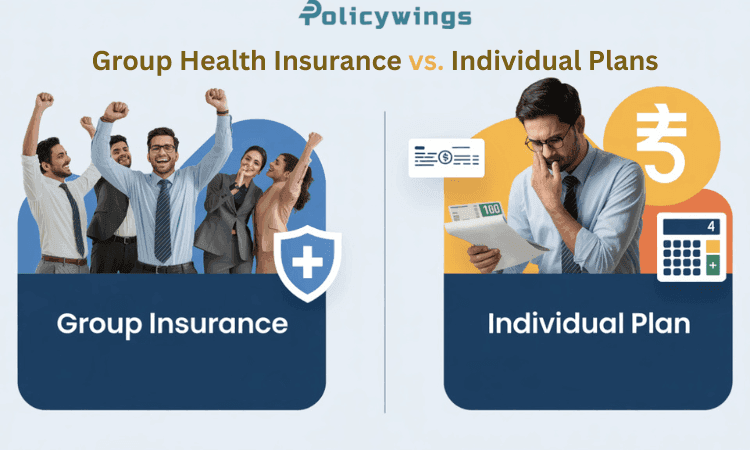
Once you hire even 5–10 people, group health insurance becomes a key talent retention tool.
Per Karoinsure.com: "Offering health insurance for employees builds trust and loyalty. It also helps startups comply with employee welfare laws while ensuring workers feel protected and valued."
Group health plans at 10+ employees can be arranged with most major insurers — HDFC ERGO, Bajaj Allianz, and ICICI Lombard are common choices for Noida startups. Group plans include Day 1 PED coverage for all employees (no waiting period), which individual retail plans cannot match.
Per NYVO.in's startup insurance checklist (April 2026): "Group health plans for 50+ employees cost ₹200–₹300/month per employee" — though at 10 employees the per-person cost is higher, the per-person value of Day 1 PED coverage is significant.
The Insurance Checklist for Noida Founders
| Insurance Type | Who Buys It | Priority | Notes |
|---|---|---|---|
| Personal Health Insurance | Founder (individual) | Immediate on leaving job | ₹15–25L SI; HDFC ERGO or Care Supreme |
| Personal Term Insurance with CI Rider | Founder (individual) | Immediate | Axis Max Life STPP with CI + WOP rider |
| Key Man Insurance | Company on founder | At first external funding | 3–5x founder's annual salary |
| D&O Liability | Company on directors | At first external funding | Investor-required at Seed/Series A |
| Group Health for Employees | Company | When first 5–10 hired | Day 1 PED, no waiting period |
| Cyber Insurance | Company + individual | Optional early stage | Critical once handling customer data |
| Professional Indemnity | Company | Sector-specific | Critical for SaaS, consulting, fintech |
The Cost Perspective
The total annual cost for Layers 1–2 (personal health and term with CI):
- Health Insurance (₹25L family floater): approximately ₹25,000–35,000/year
- Term Insurance ₹2 crore with CI rider: approximately ₹27,000–35,000/year
Total personal protection: approximately ₹50,000–70,000/year — or roughly ₹4,200–5,800/month.
Per SVB's startup founder insurance guide: "While only a few first-time founders take out insurance early on, two-thirds of repeat entrepreneurs do so." Experience teaches what first-time founders often learn the hard way: uninsured health events and key man risk are among the most common sources of startup failure beyond the business model itself.
For a Noida startup founder insurance review covering personal health, term, and business-level key man and D&O requirements, call Policywings at +91-98111-67809.
Sources: DPIIT startup count via Insurancescape.in (April 2025), Ditto CI guide (June 2026), Ditto STPP review (September 2026), GoInsureIndia Key Man guide (December 2025), Karoinsure startup insurance guide (October 2025), IncorpX business insurance guide (May 2026), NYVO startup founder checklist (April 2026), SVB founder insurance guide.
Policywings Insurance Broking Pvt. Ltd. | IRDAI License No. DB 835 | A-57, 5th Floor, Sector-136, Noida | +91-98111-67809