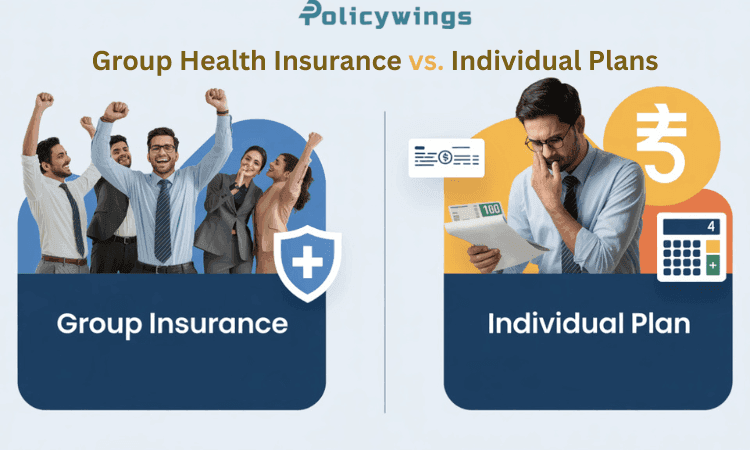
Group Health Insurance vs. Individual Plans: Which is Better for Employees?
By Sagar Narang
Group Health Insurance vs. Individual Plans: Which is Better for Employees?

You have just started a new job and everything feels exciting, until you are handed a stack of health insurance forms. Suddenly, you are faced with a big decision. Do you go with the company’s group health insurance plan or stick with an individual policy you have been managing on your own? The terms feel confusing, the coverage options are blurry and the pressure to choose wisely is real.

Table of Contents

Toggle

You are not alone. Many employees find themselves in this exact situation—trying to make sense of complex options while juggling budgets, medical needs and long-term goals. Choosing the right health insurance is not just a formality; it’s a decision that directly affects your well-being and financial security.

So, what’s truly better for employees: group health insurance or an individual plan?

The Real Appeal of Group Health Insurance: Stability, Simplicity, and Savings

Let’s see. If you’re working full-time at a company that offers group health insurance, there are several advantages that just make life easier. For one, the premiums are generally lower. Why? Because the insurance company spreads the risk across a large number of employees, making it less risky for them—and more affordable for you.

Group plans often come with richer benefits—like dental, vision, maternity, mental health coverage, and lower deductibles. Some even include wellness programs, telemedicine and free preventive care. Cool, right?

But here’s the catch—group plans are not flexible. You can not just pick and choose your features. The company decides the insurer, the coverage type and you go with the flow. Also, if you switch jobs or your employer changes carriers, your plan changes too.

Individual Health Insurance: More Control, More Customization—but More Cost

Now, let’s talk about individual health insurance. If you are self-employed, a freelancer or your employer doesn’t offer coverage, this might be your go-to.

What’s interesting here is freedom—and here we mean real freedom. You get to choose your insurer, your doctor network, your coverage level and even add-ons like critical illness or maternity riders. You can tailor it exactly to your needs. Want a plan with high outpatient benefits and international coverage? You got it.

But—and here’s the hard part—it comes at a cost. The average annual premium for individual health coverage in the U.S. was around ₹6,60,500 in 2023 and that’s before any tax credits or subsidies. That means, unless you’re getting financial assistance, you’re paying the full amount.

And don’t forget deductibles. In many individual plans, you might have to shell out ₹3.34 lakh to ₹5.01 lakh before the insurance even kicks in. Ouch, right?

Still, if you value being able to choose your providers, adjust your plan annually and not depend on an employer for your health needs, individual insurance offers independence. It’s just… not always budget-friendly.

Group vs. Individual: Key Differences in Insurance Features

To make it clearer, let’s break down the key differences in insurance features between group and individual plans:

Feature

Group Health Insurance

Individual Health Insurance

Cost

Lower premiums (usually partially paid by employer)

Higher premiums (paid entirely by the individual)

Coverage Options

Limited to the plans chosen by the employer

Wide range of options to choose from

Eligibility

All employees typically qualify, no health history check

Health history may impact coverage and premium rates

Customization

Limited customization based on employer’s offerings

Highly customizable, select coverage as needed

Flexibility in Provider Choice

Limited to network doctors and hospitals

Freedom to choose from a wider network or out-of-network

Dependents Coverage

Often includes family members, at a discounted rate

Can include family members, but often higher cost

Pre-existing Conditions

Typically covered without extra cost

May be excluded or charged higher premiums

Plan Renewal

Renewed automatically as long as you stay employed

Renewed annually, subject to underwriting and risk factors

So, Which One’s Better for You as an Employee?

If you are working at a company that offers group health insurance and they are covering most of your premium, that’s usually the better deal in terms of cost vs. coverage. It’s convenient, low-hassle and often provides excellent protection with very little legwork from your side.

Think of it like joining a club with discounted access to top-tier benefits. You are sharing the cost and risk with your coworkers and that means the insurance company gives better terms.

But if your employer does not offer health insurance—or if the group plan lacks some must-have features—an individual plan gives you the freedom to build your own healthcare safety net. You can customize coverage for your family, your specific needs or even based on chronic conditions.

It’s kind of like owning vs. renting a home. Renting (group insurance) gives you stability with fewer headaches. Owning (individual plan) gives you full control—but with more responsibility.

The “In-Between” Option Few Talk About: Supplemental & Hybrid Plans

Some employees choose to supplement their group plan with an individual policy. This is especially useful for things group policies do not always cover, like critical illness, accidental coverage or high out-of-pocket maternity expenses.

Let’s say you are covered by a group plan, but your spouse is not. You can buy an individual family floater plan just for your spouse and kids. Or you might get a low-cost accident cover on the side. It’s about bridging gaps.

Final Thoughts: It’s Not One-Size-Fits-All, But Know What Fits You Best

So, is group insurance better than individual plans for employees?

Most of the time—yes. Especially if you are offered a strong group plan and do not have special requirements. It’s cost-effective, stable and includes a good mix of features you might not get elsewhere for the same price.

But if you are someone with unique medical needs between jobs or just want total control of your healthcare choices—then individual insurance is worth considering. Yes, you will pay more—but it might be worth it.

Tip: Always check the policy features. Look for room rent limits, co-pay clauses, network hospitals, no-claim bonuses and pre-existing condition waiting periods. These little things? They make all the difference.


Share this article:

Key Services

What Makes us different from other platform?

Policywings.com is operated by Policywings Insurance Broking Services Private limited. It is duly licensed by IRDAI under its broking regulations.

At Policywings, we wish to simplify and de-jargonise Insurance

Blog

Our Blogs

Practical tips, guides, and insights to help you make smarter insurance decisions for yourself and your family.

Insurance Planning in India: A Practical Guide for Individuals and BusinessesBusiness Insurance

Insurance Planning in India: A Practical Guide for Individuals and Businesses

Introduction A lot of people treat insurance as a last-minute purchase and buy it only because it feels necessary in that moment. Sadly, they don’t fully understand what they need or why. Similarly, business insurance is also seen as a formality rather than a safety net. In reality, proper insurance planning makes a significant difference in financial stability. The right insurance policy helps individuals protect the income, health and assets of their family. For businesses, it secures their operations, employees and finances. Let’s discuss how insurance brings long-term stability and peace of mind. What Is Insurance Planning? It is the process of identifying risks and then selecting proper insurance covers that will protect against financial loss. Basically, you can better decide what kind of coverage do you actually need, how much coverage would be good enough and how policies should evolve as circumstances change. The whole point is to not buy random policies. Insurance planning is entirely focused on getting correct coverage with real needs. It could be income protection, health expenses, safety of assets and even liability risks. Why Insurance Planning Matters for Individuals Insurance planning, for individuals, is mainly about achieving financial protection and mental satisfaction. We know how unpredictable is life. Health-related expenses, sudden accidents or an unfortunate case of income loss can disturb long-term goals if there is no proper planning. insurance will help with: Income Protection A term plan is what you need to protect those who are financially dependent on you. With this, family members are able to manage daily expenses, pay off EMIs and accomplish future goals even when the earning member is no more. Health and Medical Security Medical costs can hit anyone at any time and often, they are very expensive. But when you have a planned health coverage, you can preserve your years of savings or avoid taking on debt for emergencies. Asset Protection Only a suitable insurance coverage can protect assets like cars or homes against damage, theft or big accidents. Repair or replacement costs can certainly be reduced through a well-chosen insurance policy. Long-Term Financial Discipline Insurance planning also encourages individuals to think about their financial situation practically. Hence, their protection grows along with income and responsibilities. Why Businesses Need Insurance Planning Not just individuals, even businesses need insurance planning. Beyond protection, it also supports the continuity and credibility of the company. Unexpected events can shut down operations temporarily, cause legal complications or make businesses face financial losses. However, insurance planning helps in: Operational Risk Management Businesses are prone to face risks related to property damage, safety of employees, legal liability and data security. With insurance planning, businesses can identify these risks and then assign appropriate coverage. Employee and Legal Responsibility Certain covers are really helpful to businesses in managing employee-related risks and meet legal requirements. This reduces both legal troubles and financial strain. Business Continuity Through smart planning, business operations can go on even during mishaps. This helps businesses in fast recovery without having to spend the working capital. Key Elements of Effective Insurance Planning Consider Real Risks Always start by understanding what risks can cause you financial stress. Individuals usually find it hard to deal with loss of income or medical emergencies. For businesses, it could be damage to assets, liability claims or even an operational halt. Choose Coverage Based on Needs Both under-insuring or over-insuring are big mistakes. You must choose an insurance policy that balances affordability while also promising adequate protection in need. Regular Review of Coverage Over the years, there is a change in the stage of life, income levels and business operations. By reviewing insurance from time to time, you can make sure that coverage continues to be relevant. Understand Policy Terms It’s suggested to know the inclusions, exclusions, waiting periods and even the whole claim process so that there is no confusion during emergencies. The Role of Online Insurance in Modern Planning Thanks to digitalisation, insurance planning has become quite stress-free. Many people now prefer online insurance platforms to do their research, compare options and manage different policies. When you buy insurance online, you get these benefits: Plans can be compared easily Pricing is transparent Policy is issued quickly Digital storage and easy policy renewal Besides being so convenient, the option to buy insurance online also lets you make a purchase whenever you want, without any sales pressure Mistakes to Avoid in Insurance Planning Here are some common mistakes that you must avoid to ensure effective and reliable insurance planning: Choosing policies only because of low premiums Ignoring what’s ‘not’ included and T&C of the claim Delaying purchasing a term plan Not updating coverage even after major life or business changes have happened Treating insurance as a one-time purchase and forgetting about it later Insurance Planning Is an Ongoing Process It should always be remembered that insurance needs don’t remain the same throughout. There could be an increase in your income, growth in responsibilities or expansion in businesses. Hence, coverage must be accordingly updated. Only with regular evaluation can you make sure that the insurance policy continues to serve its core purpose. In fact, today we have different online insurance platforms. They make it easier to track, update and manage multiple policies from the same site or app. Conclusion Insurance planning is about fearing but staying prepared. Both individuals or businesses need the right mix of policies to manage unexpected mishaps and protect their long-term goals. Planning can be a very practical and empowering financial decision. All you need to do is choose coverage thoughtfully and review it regularly. Also, you can buy insurance online for the most convenience. Just follow a structured approach and you can secure a safety net. For more details regarding plans and coverage, connect with PolicyWings!

Written byRahul NarangPublished onJanuary 20, 2026
Insurance Planning in India: A Practical GuideGeneral Insurance

Insurance Planning in India: A Practical Guide

Introduction A lot of people treat insurance as a last-minute purchase and buy it only because it feels necessary in that moment. Sadly, they don’t fully understand what they need or why. Similarly, business insurance is also seen as a formality rather than a safety net. In reality, proper insurance planning makes a significant difference in financial stability. The right insurance policy helps individuals protect the income, health and assets of their family. For businesses, it secures their operations, employees and finances. Let’s discuss how insurance brings long-term stability and peace of mind. What Is Insurance Planning? It is the process of identifying risks and then selecting proper insurance covers that will protect against financial loss. Basically, you can better decide what kind of coverage do you actually need, how much coverage would be good enough and how policies should evolve as circumstances change. The whole point is to not buy random policies. Insurance planning is entirely focused on getting correct coverage with real needs. It could be income protection, health expenses, safety of assets and even liability risks. Why Insurance Planning Matters for Individuals Insurance planning, for individuals, is mainly about achieving financial protection and mental satisfaction. We know how unpredictable is life. Health-related expenses, sudden accidents or an unfortunate case of income loss can disturb long-term goals if there is no proper planning. insurance will help with: Income Protection A term plan is what you need to protect those who are financially dependent on you. With this, family members are able to manage daily expenses, pay off EMIs and accomplish future goals even when the earning member is no more. Health and Medical Security Medical costs can hit anyone at any time and often, they are very expensive. But when you have a planned health coverage, you can preserve your years of savings or avoid taking on debt for emergencies. Asset Protection Only a suitable insurance coverage can protect assets like cars or homes against damage, theft or big accidents. Repair or replacement costs can certainly be reduced through a well-chosen insurance policy. Long-Term Financial Discipline Insurance planning also encourages individuals to think about their financial situation practically. Hence, their protection grows along with income and responsibilities. Why Businesses Need Insurance Planning Not just individuals, even businesses need insurance planning. Beyond protection, it also supports the continuity and credibility of the company. Unexpected events can shut down operations temporarily, cause legal complications or make businesses face financial losses. However, insurance planning helps in: Operational Risk Management Businesses are prone to face risks related to property damage, safety of employees, legal liability and data security. With insurance planning, businesses can identify these risks and then assign appropriate coverage. Employee and Legal Responsibility Certain covers are really helpful to businesses in managing employee-related risks and meet legal requirements. This reduces both legal troubles and financial strain. Business Continuity Through smart planning, business operations can go on even during mishaps. This helps businesses in fast recovery without having to spend the working capital. Key Elements of Effective Insurance Planning Consider Real Risks Always start by understanding what risks can cause you financial stress. Individuals usually find it hard to deal with loss of income or medical emergencies. For businesses, it could be damage to assets, liability claims or even an operational halt. Choose Coverage Based on Needs Both under-insuring or over-insuring are big mistakes. You must choose an insurance policy that balances affordability while also promising adequate protection in need. Regular Review of Coverage Over the years, there is a change in the stage of life, income levels and business operations. By reviewing insurance from time to time, you can make sure that coverage continues to be relevant. Understand Policy Terms It’s suggested to know the inclusions, exclusions, waiting periods and even the whole claim process so that there is no confusion during emergencies. The Role of Online Insurance in Modern Planning Thanks to digitalisation, insurance planning has become quite stress-free. Many people now prefer online insurance platforms to do their research, compare options and manage different policies. When you buy insurance online, you get these benefits: Plans can be compared easily Pricing is transparent Policy is issued quickly Digital storage and easy policy renewal Besides being so convenient, the option to buy insurance online also lets you make a purchase whenever you want, without any sales pressure Mistakes to Avoid in Insurance Planning Here are some common mistakes that you must avoid to ensure effective and reliable insurance planning: Choosing policies only because of low premiums Ignoring what’s ‘not’ included and T&C of the claim Delaying purchasing a term plan Not updating coverage even after major life or business changes have happened Treating insurance as a one-time purchase and forgetting about it later Insurance Planning Is an Ongoing Process It should always be remembered that insurance needs don’t remain the same throughout. There could be an increase in your income, growth in responsibilities or expansion in businesses. Hence, coverage must be accordingly updated. Only with regular evaluation can you make sure that the insurance policy continues to serve its core purpose. In fact, today we have different online insurance platforms. They make it easier to track, update and manage multiple policies from the same site or app. Conclusion Insurance planning is about fearing but staying prepared. Both individuals or businesses need the right mix of policies to manage unexpected mishaps and protect their long-term goals. Planning can be a very practical and empowering financial decision. All you need to do is choose coverage thoughtfully and review it regularly. Also, you can buy insurance online for the most convenience. Just follow a structured approach and you can secure a safety net. For more details regarding plans and coverage, connect with PolicyWings!

Written byRahul NarangPublished onJanuary 27, 2026