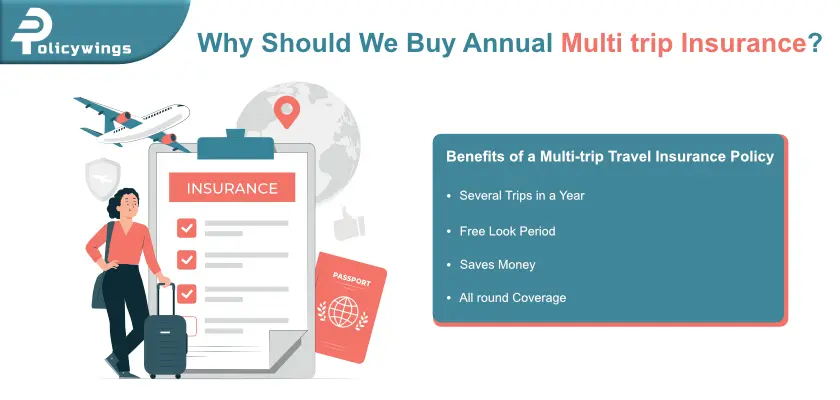
Why Should We Buy Annual Multi trip Insurance?
By Sagar Narang
Why Should We Buy Annual Multi trip Insurance?

Homepage  > Articles >

Why Should We Buy Annual Multi trip Insurance?

Table of Contents

Toggle

Why Should We Buy Annual Multi trip Insurance?

By Sagar Narang
Why Should We Buy Annual Multi trip Insurance?

If you’re getting insurance for your car, your pets, your health, and your home, then why not annual multi trip travel insurance?

With multi-trip insurance, you can save both time and money and travel worry-free. 

So, if you love to travel or your job requires frequent traveling, then this is the blog that you should read, till the end to understand everything about multi-trip travel insurance. 

Even the best-planned trip can be ruined by a flight delay or cancellation, baggage loss, or an accident.

And insurance is made to help you in uncertain times. 

Let’s understand how multi-trip travel insurance is beneficial for you. 

About Annual Multi-trip Insurance

An multi-trip insurance is travel insurance that covers more than one trip in a year. It is considered an ideal travel insurance plan for frequent travelers who fly to different destinations either for work or leisure purposes. 

So, basically, instead of paying for travel insurance every time you go on a business trip, a single premium will cover all your trips during the policy year. 

However, there are some conditions attached to a multi-trip insurance policy. Such as, for an annual multi-trip travel insurance policy, the maximum duration for one trip can either be 30, 45, 60, or 90 days. 

(When purchasing, make sure to read the terms listed on the policy document, related to the maximum duration for one trip.)

How Multi-trip Travel Insurance Works? 

Many people, like business heads, corporate executives, and freelancers, travel to different countries frequently for seminars and business meetings. 

Thus, it becomes increasingly important for these people to plan their travel budgets, like flight tickets, hotel bookings, and emergency expenses, ahead of time. 

Moreover, it’s always better to be ready for the future in order to have some certainty and security. This is where multi-trip insurance can be of great help. 

To explain it more precisely, 

Consider having multi-trip travel insurance. Over the course of the year, you take several trips, including a weekend getaway to a nearby city with your family, and two business trips abroad.

Your multi-trip insurance policy will provide coverage for all these trips, along with emergency medical expenses and flight cancellations for each trip. 

Benefits of a Multi-trip Travel Insurance Policy

Some of the benefits or we say, features of a multi-trip insurance policy are:

Several Trips in a Year

An multi-trip travel insurance gives coverage for an unlimited number of trips in a single year, with each single trip of 30-60 days duration. Therefore, it’s an economical way to cover multiple trips. 

Free Look Period

Only a multi-trip insurance plan offers a free look period. So, if you have any objections to the terms of your travel policy, you can cancel your play within the initial 15 days and get a full refund. 

Saves Money

A multi-trip insurance policy is a cost-saving option because, even if you travel three to five times a year, you would not have to pay for travel insurance three to five times. 

All round Coverage

If any medical emergency occurs, while you are on a trip, your insurance will take care of everything, from hospital expenses to evacuation. This way, you can travel worry-free.

Who Should Choose Multi-trip Insurance?

A multi-trip annual travel insurance India is a budget-friendly insurance plan for all frequent travelers. 

However, if you are still unsure about whether to purchase single-trip or multi-trip travel insurance, take a look at the categories listed below.

If you fit into any of the categories listed below, you should consider purchasing an annual travel insurance policy.

  1. If you have more than 2 trips planned in the upcoming year.
  2. If you are an impulsive traveler. 
  3. You have to travel frequently for your work or business. 

To conclude, 

If you fit into any of these categories, then annual multi-trip insurance is the right travel plan for you. 

Moreover, if you are uncertain about where to buy the insurance, then the best way here is to compare multi-trip travel insurance plans in terms of costs, features, and benefits. 

Visit PolicyWings website, to compare and get the best multi-trip insurance policy, or simply contact our team.

FAQs

What is annual multi-trip insurance?

An annual multi-trip insurance is defined as a travel insurance plan that covers multiple trips within a policy year.

Is it better to get a single trip or annual travel insurance?

Ideally, if you take more than two trips in a year then you should opt for an annual multi-trip travel insurance. Otherwise, it’s better to choose single-trip insurance.

What are the advantages of annual multi-trip insurance?

A few of the benefits of annual multi-trip insurance are- 

  • Unlimited trips a year
  • Cost-effective
  • All round coverage
  • Free look period

Share this article:

More on Travel Insurance

Hand-picked reads on travel insurance to help you decide with confidence.

Business Travel Insurance India: Is It Essential for Corporate Travellers?Travel Insurance

Business Travel Insurance India: Is It Essential for Corporate Travellers?

Unexpected challenges have become a common feature of today’s global business outlook. For many travelling professionals having the correct business travel cover means the difference between flawless operations and costly disorganisation. In India the travel insurance for corporate travelers has evolved from being merely optional to becoming a planning necessity, supported by practical benefits and growing legal recognition. Why It’s More Than Just a Protection Business journeys can expose employees and the organisations to diverse risks, which include: Medical emergencies abroad which are paramount to excessive costs without proper coverage. Trip cancellations or holdup/delays can be affected by weather, civil unrest or logistical failures. Loss of baggage or essential business gadgets or equipment like laptops or documents. Legal liabilities arising abroad from third party injury or property damage. Emergency evacuation and repatriation, which can include scenarios of critical health crises or death. Comprehensive business travel policies in India address these by extensive protection offerings such as emergency medical aid, repatriation, document loss, baggage delays and personal liability/travel insurance or business travel cover. Legal Regulations and Precedents Many recent legal results highlight the practical importance of correct travel insurance: In Ghaziabad’s District Consumer Disputes Redressal Commission a couple was given an award of INR 1.9 lakh after their insurance provider falsely classified a cancelled international flight as a delay. The court found inconsistencies in service under the Consumer Protection Act and upheld the rightful full claim amount. The devastating plane crash in Ahmedabad left a broad range of travel and personal insurance claims from baggage loss to life cover underlining how the business insurance provides important financial support in disastrous events. These rulings reinforce that strong business travel cover offers financial security and also legal validation for claims properly documented. Advantage for Corporate Travel Insurance Financial Protection: Medical expenses abroad can shoot up fast. A correct business travel policy makes sure that financial security by hospitalisation, treatment or emergency evacuation coverage eliminates fear of out of pocket burdens. Operational Continuity: Delays and cancellations are the inconveniences. And they disrupt tightly planned meetings or negotiations. Business travel insurance policies often cover nonrefundable costs and ancillary expenses, helping retain business continuity. Protecting Critical Assets: Corporate travelers mostly have to carry certain important equipment and documents and Insurance covers loss, damage, theft or delay of baggage, passports and devices which can totally minimise the operational difficulties and complicated situations. Emergency Assistance or Response and Legal Cover: Policies usually set 24/7 assistance which are mainly for medical coordination, local support, repatriation or legal liaison. They might also cover third party liability claims sustained while travelling. Compliance and Decreasing Risk Some countries require travel insurance as a precondition for visa issuance coverage levels and duration mostly specified. Failing to comply can endanger visa approval or entry. Without proper business travel cover the employees and their organisations risk financial exposure can have potential claim rejections or insufficient recourse in emergencies. Consequences of not having it Refused claims like misidentification of cancellations which can result in limited or partial reimbursement. The Ghaziabad case serves as a preventive precedent. Insufficient coverage can lead to uncovered expenses such as replacement of equipment, legal disputes or emergency evacuations which are not in the policy. In critical situations there can be a lack of instant assistance that can intensify risks, delay responses or shoot up liabilities. How to Select the Right Business Travel Cover Make sure that it has a wide scope which includes medical, cancellation, baggage, evacuation, liability and repatriation cover. Customise to select single trip or multi trip covers depending on travel occurrence and make sure that coverage limits match the destination risk profiles. Understand the exclusions and the common exclusions include pandemics, war or preexisting conditions. Review/recheck policy gradation thoroughly. Choose providers offering constant active assistance 24/7 support, claim facilitation and local coordination improve real time security. Conclusion Integrating travel insurance into the corporate travel policy outlines is no longer just advisable it’s crucial. By protecting financial liabilities by enabling swift emergency response and providing legal recourse then a business travel cover makes sure that the corporate travelers can centre the focus on their target with reliance and confidence. From present consumer court precedents to developing global risks the case is clear that comprehensive business travel insurance is a planning and strategic asset and not a load on budgets. For corporate entities dedicated to employee welfare, operational continuity and sensible risk management this is a nonnegotiable investment.

Written bySagar NarangPublished onSeptember 30, 2025

You may also like: Motor Insurance

Related guides from our motor insurance desk.

Car Insurance Policy Explained: Coverage, Add-Ons and Claim ProcessCar Insurance

Car Insurance Policy Explained: Coverage, Add-Ons and Claim Process

Introduction You have waited so long to finally purchase that car, saved for it and checked all those reviews. And now that you have it, would you really take the risk of driving it without proper car insurance? Just one accident, a scratch or major repair work can cost you so much. This is why the right car insurance policy is as important as the right vehicle. But the problem is that a lot of people buy the cheapest insurance for car. They think that it’s enough for complete protection, when actually, these basic policies often offer only partial protection. For full-on protection, you need add-ons like bumper to bumper insurance along with proper understanding of how the claim process actually works. Let’s learn about it all! What Is a Car Insurance Policy? In simple terms, a car insurance policy is an agreement between you and your insurance provider. In this, you pay a set premium and in return, you will get financial protection during events like: Accidents Theft Fire Natural disasters Injury or property damage to third party In India, it’s compulsory to get a third-party insurance. However, it only covers the damage that you have caused to someone else and not your own car. That is the reason most car owners want comprehensive car insurance. Types of Car Insurance Policies in India Third-Party Car Insurance As per the law, it’s a mandatory requirement for all car owners. It covers damage caused to another person, vehicle or property Your own car is not covered in it It’s usually the cheapest insurance for car but not ideal fin terms of protection Comprehensive Car Insurance This one is recommended for all car owners because: It covers your car as well as third-party damage Provides protection against accidents, theft, fire and natural disasters Bumper to bumper insurance add-on makes it even more beneficial What All Does Comprehensive Car Insurance Cover? All car owners must ideally choose a comprehensive plan. It gives peace of mind and helps avoid hassles. This is what it usually includes: Damage that happened because of an accident Fire and explosion Floods, storms, earthquakes etc Theft Vandalism / riots Cover for personal accident Third-party liabilities What Is Not Covered? These are the exclusions that you must know of because this will help you avoid claim rejections. Accidents because of drunk driving Driving without a licence Mechanical breakdown Normal wear and tear Electrical failure Damage happened outside of the policy period Using a private car but for commercial use Add-Ons For Better Protection Add-ons are the extra yet optional covers that you can include to enhance your car insurance policy. Below are the most useful ones to consider: Bumper to Bumper Insurance (Zero Dep): This one is definitely the most popular add-on because it ensures no depreciation deduction during claims. Here, your insurer takes care of the full repair amount. It’s perfect for: New cars High-end cars Driving in cities with heavy traffic Engine Protect: It covers the damages that arise because of the entry of water, oil leakage or maybe a hydrostatic lock. Roadside Assistance: Helps with towing, jump start, battery help etc. Gives huge support during breakdowns. Return to Invoice (RTI): In case your car gets stolen or is totally damaged, you will get the original invoice amount and not the depreciated amount. Key Replacement Cover: Covers for the lost or stolen keys and is highly useful for high-tech keys. Consumables Cover: Items like nuts, bolts, engine oil and AC gas, that are usually excluded, are covered in this add-on. While add-ons like bumper to bumper insurance charge a little much, you also get to save a lot of money during repairs How to Choose the Right Car Insurance Plan? The aim is to balance protection and price. Here’s how you do it: Don’t just go on and pick the cheapest insurance that you get • Compare coverage and claim settlement ratio of multiple options • Always choose the correct IDV (Insured Declared Value) • Add zero depreciation cover for newer cars • Check the number of network garages listed with the insurer • Always read exclusions carefully If you compare smartly, you can totally ensure maximum protection without overspending. Steps in Car Insurance Claim Process If you follow these steps, it’s actually very easy to file a claim: Step 1: Immediately Inform the Insurer: Most insurers need you to notify them within 24–48 hours. Step 2: Take Photos of the Damage: When you have clear pictures, it helps in fast approval. Step 3: File an FIR: This is normally required for theft or major third-party damage. Step 4: Visit a Network Garage: The repairs are cashless. No upfront payment needed. Step 5: Surveyor Inspection: A surveyor checks the damage caused and gives approval for the repair estimate. Step 6: Repairs Begin: Garage starts working on your after getting approval. Step 7: Settlement: For cashless claims, the insurer pays directly to the garage. If applicable, you need to pay only for the deductibles. How to Lower Your Premium Without Losing Coverage These tips will help you enjoy good protection without have to spend more than required: Always renew on time • Don’t set a very low IDV • Make wise use of No-Claim Bonus • Install anti-theft devices in the car • Before renewal, compare different plans • Drive safely so that there are no frequent claims. Conclusion A car insurance policy is not just a legal compulsion but a financial protection against unexpected expenses of repairs. While cheapest insurance for car may seem more attractive but it often offers limited coverage. The smart thing to do is opting for a comprehensive plan with the right add-ons. This will give the most benefits. Understand the coverages, exclusions and the claim process and you can secure the most suitable policy. If you want easy comparison and expert guidance, Policywings can help you make the right decision!

Written byRahul NarangPublished onDecember 17, 2025

Explore: Health Insurance

Broaden your view with a quick read on health insurance.

Health Insurance Plans for Family: Compare, Buy & SaveHealth Insurance

Health Insurance Plans for Family: Compare, Buy & Save

Introduction Rushing to the hospital for an emergency and coming back with a bill of lakhs of rupees is such a nightmare. Nobody even wants to imagine being in such a situation. Medical expenses are getting out of hand and it’s literally so unaffordable for so many of us. You go for a treatment once and all your savings are shaken. This is where having the best health insurance policy for family in place is so important. It ensures that your family gets the best treatment without you having to worry about expenditures. Let’s discuss health insurance, how to pick the right health insurance plans and how having insurance for family can save money while keeping your family protected. What is Health Insurance for Family? Health insurance is a financial tool that comes in handy when you need to pay your medical bills. It covers the treatment for illness, injury or hospitalization and relieves you from the stress. You don’t have to pay entirely from your pocket because, as per the policy, it’s on your insurance provider. Health insurance plans are very helpful. A single plan covers your spouse, children and sometimes even parents. This is generally known as a family floater health insurance where, instead of buying separate policies for everyone, you pay a single premium and then the coverage is shared by all members of the family. Let’s say you buy a family floater plan of ₹15 lakh. Now, any person covered under it can use it as and when needed. Why Do You Need Health Insurance for Family? Everyone needs a financial cover that will help them in medical situations. Here are the reasons why health insurance for family is essential: Rising Medical Costs– Hospital admission can be a matter of lakhs, but health insurance plans save you as well as your savings. Complete Protection– Doctor fees, medicines, hospital admission, surgeries and some other treatments are also all covered. Peace of Mind– When your family is financially secure, you don’t have to worry about anything else. Cashless Treatment– You don’t have to run around to arrange for money because many health insurance plans offer cashless treatment in listed hospitals. Tax Benefits– There is no tax on the premiums that you pay for the best health insurance policy for family. Key Features of Health Insurance Plans for Family Below are some important features that you need to consider while choosing the best health insurance policy for family: Sum Insured– The total coverage amount matters the most. Cashless Network Hospitals– The insurance company must have tie-ups with good hospitals near your location. Pre & Post-Hospitalization– All or most expenses before and after hospitalization have to be covered. Daycare Procedures– Many plans also include surgeries that don’t need 24-hour admission. Maternity Cover– Some health insurance plans also cover maternity and newborn, so see if that’s what you need. Restoration Benefit– If you use up the full cover amount, some plans even restore it for the rest of the year. No-Claim Bonus– If you didn’t have to make a claim in a year, your sum insured gets increased without any extra cost. Family Floater vs Individual Health Insurance While getting insurance for family, people often can’t decide between family floater plans and individual plans but this simple comparison will help you decide: Feature Family Floater Individual Plan Coverage Shared among all members covered Separate for each family member Premium Usually economical Higher because you buy separate plans Best for Families with young people and kids Families with elderly members If the family members are around a similar age and everyone is in good health, a family floater health insurance is a very good option but if you have elderly at home, it’s always wiser to get them individual plans. How to Compare Health Insurance Plans for Family Today, there are just so many options available. This makes choosing the best health insurance policy for family quite overwhelming. Keeping in mind these points would really help: Check the Coverage– Make sure that the sum insured is enough for a family of up to 5 members, considering the standard medical costs. Look for Room Rent Limits – Some plans have a cap on room rent. A higher coverage lets you choose a better hospital room. Claim Settlement Ratio (CSR)– A higher CSR of the insurance company means it easily settles most claims. Cashless Hospitals– With more tie-ups with reputed hospitals, the treatment process becomes hassle-free. Inclusions & Exclusions– Carefully go through the documents to know what’s covered and what’s not. Waiting Periods– There may be a 2-4 year waiting period for pre-existing diseases and getting maternity benefits. Premium vs Benefits– Don’t jump on the first cheapest plan. There has to be a balance of affordability and benefits. Steps to Buy Health Insurance for Family You can always buy the right health insurance plans if you follow these steps: Assess Your Needs– The plan has to align with your family size, age, lifestyle and existing health issues (if any). Choose the Sum Insured– Be realistic with the amount and choose the sum that can cover even big medical expenses. Compare Plans Online– You can use comparison tools online to see a side-by-side comparison of premiums, coverage and benefits. Check Add-ons– In case you need it, you can also add maternity cover, critical illness cover or even personal accident. Read Policy Documents– Read the fine print carefully to not skip any important point about what’s included and excluded. Buy Online– At times, purchasing online is more affordable and even comes with extra discounts. Tips to Save on Health Insurance for Family We have some good times that will come in handy while buying health insurance: Buy Early– When you buy at a younger age, you generally have to pay lower premiums. Choose Family Floater– It’s certainly cheaper compared to getting multiple individual plans. Opt for Long-Term Plans– Long-term policies like 2–3 years come with good discounts. No-Claim Bonus–

Written byRahul NarangPublished onSeptember 20, 2025