Why Is High-Altitude Trekking Insurance Mandatory For a Trek?
By Rahul Narang
Why Is High-Altitude Trekking Insurance Mandatory For a Trek?

Homepage  > Articles >

Why Is High-Altitude Trekking Insurance Mandatory For a Trek?

Table of Contents

Toggle

Why Is High-Altitude Trekking Insurance Mandatory For a Trek?

By Rahul Narang
Why Is High-Altitude Trekking Insurance Mandatory For a Trek?
  • July 2, 2024

Trekking is one adventurous activity that every city person wants to experience once in life. However, nature adventures like trekking and hiking involve risks. That’s why taking high-altitude trekking insurance becomes a necessity. 

Trekking isn’t considered a big investment like buying a home. But, during high-altitude trekking, there are chances of landslides or avalanches on mountains due to unpredictable weather. Or you can find yourself with fractures and sprains or other injuries and illnesses that are highly probable for trekkers. 

And if you are someone like me with no daily fitness routine then you should consider buying a high-altitude trekking insurance before escaping from city lights to starry nights in mountains. 

Here in this article, you will get every single detail about high-altitude trekking insurance, so keep reading. 

Why You Need High Altitude Trekking Insurance?

Call it trekking or hiking, it has become a trend these days among all working individuals for all positive reasons. Relaxing on the beach or beside a pool is indeed pleasant, but breathing pure air in serenity while hopping over mountains is a rejuvenating experience. 

You not only get an adrenaline buzz from all the risky paths but also get off the beaten tracks to explore some awe-inspiring scenery. 

So, whether you want to trek alone or with friends in the group, you need to have high-altitude trekking insurance. As it will give you and your family peace of mind and an assurance of being covered if any mishaps occur along the way. 

Also, in the majority of the treks, the height is more than 3000 meters, so the chance of getting hit by AMS (Acute mountain sickness) is very real.

For example, trekking is almost always done in high, isolated areas where it is difficult to get medical assistance quickly.

So, a general complication like sprained ankles or fractured bone, could require a rescue team and helicopter if these incidents occur at isolated terrains. 

Therefore, if anything goes south, you can relax knowing that things can be taken care of with high-altitude trekking insurance.

What is High Altitude Trekking Insurance?

High altitude trekking insurance is introduced for all the thrill and adventure seekers who wish to see more of nature by trekking at high places for the best views. 

Moreover, trekking involves going to high altitudes, so a trekking insurance policy is divided based on different altitudes to offer full benefits. Such as, there is trekking insurance for up to 6,000m, trekking insurance for up to 5000m, 4000m, and 3000m.

So you have options in trekking insurance and you have to pick the right high-altitude trekking insurance policy for your specific trek. 

High Altitude Trekking Insurance: Covered & Not Covered

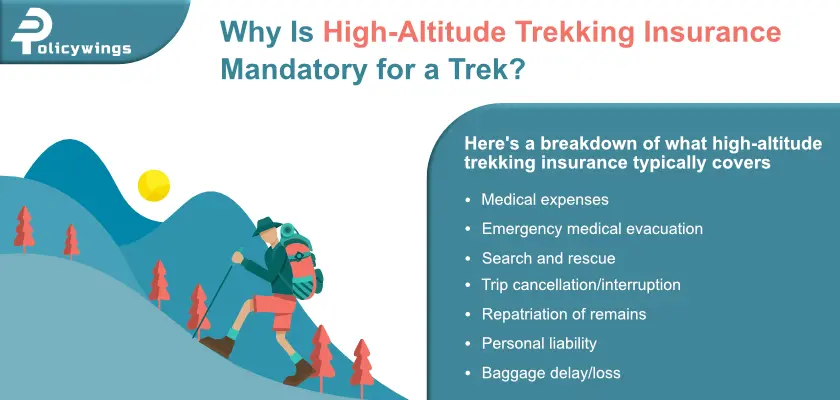
Here’s a breakdown of what high-altitude trekking insurance typically covers:

  • Medical expenses: This includes costs associated with illness or injury sustained while trekking, including hospitalization, medication, and doctor consultations.
  • Emergency medical evacuation: Helicopter evacuation can be life-saving at high altitudes, and this insurance can cover the cost of getting you to medical care.
  • Search and rescue: If you get lost or stranded, search and rescue operations can be expensive. High-altitude trekking insurance can cover these costs.
  • Trip cancellation/interruption: Even if you don’t need medical care, unexpected events can disrupt your trek. This insurance can reimburse you for non-refundable trip costs if you have to cancel or cut your trek short due to covered reasons.
  • Repatriation of remains: This covers the cost of transporting your remains home in case of a fatality.
  • Personal liability: If you accidentally injure someone or damage property during your trek, this could cover the associated legal costs.
  • Baggage delay/loss: It covers the cost of replacing lost or stolen items if they are delayed or lost at high altitudes.

However, points not covered under trek insurance are:

  • If the trekker experiences hallucinations because of drugs or alcohol. 
  • If the trekker breaks any law of the particular area. 
  • If the trekker has any pre-existing disease.
  • If the trekker does intentional self-injury.

To Conclude, 

By understanding your needs and comparing plans thoroughly, you can find high-altitude trekking insurance that provides peace of mind and financial protection for your adventurous journey in the mountains. 

And if not, PolicyWings is here to help you. Being an insurance broking service provider, our team is always there to assist you in buying the best policy available in the market.

This long weekend, if you plan to escape to nature, contact us, and we will help you purchase the best high-altitude trekking insurance available on the market.

FAQs

What is a high-altitude trek?

A high-altitude trek involves hiking or trekking in mountainous regions typically above 3000 meters. It requires acclimatization due to lower oxygen levels and offers challenging yet rewarding experiences with stunning landscapes and unique ecosystems.

Which travel insurance is best for trekking up to 6,000m in India?

There are many popular travel insurance for trekking up to 6,000 meters in India, covering emergency medical expenses, evacuation, and trip cancellations, ensuring comprehensive protection during high-altitude adventures.
PolicyWings will help you grab the best trekking insurance policy available in India.

What are the benefits of High Altitude Trek Insurance?

High altitude trek insurance provides several benefits such as coverage for emergency medical expenses, evacuation in case of altitude sickness or injury, trip cancellations, and lost or damaged equipment, ensuring safety and financial protection during challenging treks.

What is the best travel insurance for Mount Everest?

The best travel insurance for the Mount Everest trek is a high-altitude trekking insurance that offers coverage for emergency medical expenses, evacuation, trip cancellations, and gear protection, ensuring comprehensive safety for climbers.

How much does trek insurance cost?

The cost of trek insurance varies according to the coverage, length, and elevation of the journey, giving daring tourists peace of mind and financial security.


Share this article:

More on Travel Insurance

Hand-picked reads on travel insurance to help you decide with confidence.

Business Travel Insurance India: Is It Essential for Corporate Travellers?Travel Insurance

Business Travel Insurance India: Is It Essential for Corporate Travellers?

Unexpected challenges have become a common feature of today’s global business outlook. For many travelling professionals having the correct business travel cover means the difference between flawless operations and costly disorganisation. In India the travel insurance for corporate travelers has evolved from being merely optional to becoming a planning necessity, supported by practical benefits and growing legal recognition. Why It’s More Than Just a Protection Business journeys can expose employees and the organisations to diverse risks, which include: Medical emergencies abroad which are paramount to excessive costs without proper coverage. Trip cancellations or holdup/delays can be affected by weather, civil unrest or logistical failures. Loss of baggage or essential business gadgets or equipment like laptops or documents. Legal liabilities arising abroad from third party injury or property damage. Emergency evacuation and repatriation, which can include scenarios of critical health crises or death. Comprehensive business travel policies in India address these by extensive protection offerings such as emergency medical aid, repatriation, document loss, baggage delays and personal liability/travel insurance or business travel cover. Legal Regulations and Precedents Many recent legal results highlight the practical importance of correct travel insurance: In Ghaziabad’s District Consumer Disputes Redressal Commission a couple was given an award of INR 1.9 lakh after their insurance provider falsely classified a cancelled international flight as a delay. The court found inconsistencies in service under the Consumer Protection Act and upheld the rightful full claim amount. The devastating plane crash in Ahmedabad left a broad range of travel and personal insurance claims from baggage loss to life cover underlining how the business insurance provides important financial support in disastrous events. These rulings reinforce that strong business travel cover offers financial security and also legal validation for claims properly documented. Advantage for Corporate Travel Insurance Financial Protection: Medical expenses abroad can shoot up fast. A correct business travel policy makes sure that financial security by hospitalisation, treatment or emergency evacuation coverage eliminates fear of out of pocket burdens. Operational Continuity: Delays and cancellations are the inconveniences. And they disrupt tightly planned meetings or negotiations. Business travel insurance policies often cover nonrefundable costs and ancillary expenses, helping retain business continuity. Protecting Critical Assets: Corporate travelers mostly have to carry certain important equipment and documents and Insurance covers loss, damage, theft or delay of baggage, passports and devices which can totally minimise the operational difficulties and complicated situations. Emergency Assistance or Response and Legal Cover: Policies usually set 24/7 assistance which are mainly for medical coordination, local support, repatriation or legal liaison. They might also cover third party liability claims sustained while travelling. Compliance and Decreasing Risk Some countries require travel insurance as a precondition for visa issuance coverage levels and duration mostly specified. Failing to comply can endanger visa approval or entry. Without proper business travel cover the employees and their organisations risk financial exposure can have potential claim rejections or insufficient recourse in emergencies. Consequences of not having it Refused claims like misidentification of cancellations which can result in limited or partial reimbursement. The Ghaziabad case serves as a preventive precedent. Insufficient coverage can lead to uncovered expenses such as replacement of equipment, legal disputes or emergency evacuations which are not in the policy. In critical situations there can be a lack of instant assistance that can intensify risks, delay responses or shoot up liabilities. How to Select the Right Business Travel Cover Make sure that it has a wide scope which includes medical, cancellation, baggage, evacuation, liability and repatriation cover. Customise to select single trip or multi trip covers depending on travel occurrence and make sure that coverage limits match the destination risk profiles. Understand the exclusions and the common exclusions include pandemics, war or preexisting conditions. Review/recheck policy gradation thoroughly. Choose providers offering constant active assistance 24/7 support, claim facilitation and local coordination improve real time security. Conclusion Integrating travel insurance into the corporate travel policy outlines is no longer just advisable it’s crucial. By protecting financial liabilities by enabling swift emergency response and providing legal recourse then a business travel cover makes sure that the corporate travelers can centre the focus on their target with reliance and confidence. From present consumer court precedents to developing global risks the case is clear that comprehensive business travel insurance is a planning and strategic asset and not a load on budgets. For corporate entities dedicated to employee welfare, operational continuity and sensible risk management this is a nonnegotiable investment.
Written bySagar NarangPublished onSeptember 30, 2025

You may also like: Motor Insurance

Related guides from our motor insurance desk.

Zero Depreciation vs Bumper-to-Bumper Car InsuranceCar Insurance

Zero Depreciation vs Bumper-to-Bumper Car Insurance

Introduction While buying or renewing car insurance, you would surely come across two very common terms: Zero Depreciation and Bumper to Bumper cover. A lot of people either assume that these both are different offerings or that maybe one is better than the other. It’s okay if you don’t know exactly what is this. In this blog, we will explain what zero depreciation and bumper to bumper insurance actually mean so that you don’t skip it to get the cheapest insurance for car or mindlessly add it without knowing its real value. Why Do You Need It? During the time of a claim, your payout can be greatly reduced because of depreciation. However, having zero depreciation (also called bumper-to-bumper) helps a lot here. Once you get it, you can: Avoid unpleasant surprises at the time of claim Decide if the extra premium is worth the expense Choose the right car insurance as per the age and usage of your vehicle Is Zero Dep Different Than Bumper-to-Bumper Insurance? The simple answer is NO! They both are exactly the same thing. Basically, Zero Depreciation and Bumper-to-Bumper Insurance are two names for the same add-on cover. There is absolutely no important or coverage difference between the both. Why are There Two Names for the Same Cover? Zero Depreciation is a technical term in insurance Bumper-to-Bumper Insurance is more of a consumer-friendly name Whether insurance companies or aggregator websites, they use both terms interchangeably. This makes it easier for buyers to understand the concept and then purchase it. What Is Zero Depreciation or Bumper-to-Bumper Insurance? It is a very practical add-on cover that can be bought with any of these: Comprehensive car insurance Standalone own damage policy Just remember that it is not a standalone car insurance policy in itself. What Does it Cover? When you have bumper to bumper insurance, the insurance provider does not deduct any depreciation on replaced parts when you are making a claim. This includes: Plastic parts Rubber elements Fibre components Metal body parts Be sure to get a higher claim payout which is pretty close to the actual repair cost. What It Does Not Cover Even if you have zero dep add on, expect that: There would be limits on tyres, batteries and consumables You would need a separate add-on for engine damage Claims that go beyond allowed count may go back to normal depreciation Example of Difference Between Depreciation and Zero Dep Replaced Part With Regular Policy With Zero Dep / Bumper-to-Bumper Plastic bumper 50% depreciation cut No depreciation deduction Door panel Approx. 30–40% deducted Fully covered Net claim amount Lower Higher And when it’s about major parts, the difference becomes very clear. Does Bumper-to-Bumper Mean Higher Premium? Well, yes, but there is a valid reason. It adds 10–20% to the premium for own damage Often helps you save a lot more during claims And if your car is newer, the out-of-pocket expenses are cut down very much. While it’s true that it may not be part of the cheapest insurance for car, it often proves to be more economical when it comes to practical life cases. Who Should Choose Zero Dep / Bumper-to-Bumper Insurance? It is highly recommended if: Your car is less than or 5 years old You live in crowded cities and drive in heavy traffic You want the claim payouts to be predictable You want full peace of mind if accidents happen However, it may not be necessary if: Your car is old and its value is low The cost of repair is minimal All you want is to get the cheapest insurance for car Is Zero Dep Available for All Cars? Here are a few points to be kept in mind regarding this add-on: It is available for cars that are up to 5 years old There may be limits on the claim like 2–3 per year Terms vary as per the insurance provider This is why it’s would be good to always check the T&C of the policy before buying. Clearing Common Misconceptions “Zero Dep is a separate policy”: It’s actually an add-on and not a policy “Bumper-to-Bumper covers everything”: It only removes depreciation. All the exclusions have to be followed “It’s useless after one year”: It remains helpful and effective for multiple years and especially in cities Why it Should Be Your Car Insurance Choice When you are renewing or buying car insurance, the biggest decision you make is between: Whether to go for lower premium with higher repair costs Choose slightly higher premium with better claim payoffs If your biggest focus is to secure the cheapest insurance for car, you may just skip getting zero dep. However, if the goal is getting optimum cost and protection, it really makes sense to get this add-on. Conclusion Let’s make it very clear that there is simply no difference between zero depreciation and bumper to bumper insurance. Only the names are different. What really matters is whether your car is valuable enough for it, does the driving conditions increase the risk of damage risk or how much surprises can you handle during claims. If this add-on is chosen wisely, it can make your car insurance far more effective.

Written bySagar NarangPublished onDecember 29, 2025
How to Reduce Car Insurance Premiums without Losing CoverageCar Insurance

How to Reduce Car Insurance Premiums without Losing Coverage

As a car owner in India, it’s a must to get insurance for it. But you don’t have to overpay for it. Many people just assume that by cutting down on coverage they can secure the cheapest insurance for car. However, this will only backfire during a claim. The focus should always be on lowering your premium while holding on to the necessary protection. Here, we bring to you the smartest ways that will help bring down the cost of your car insurance and maintaining the necessary benefits. Practical Ways to Lower Your Car Insurance Premium You don’t have to remove essential coverage for reducing the premium of your car insurance. let’s discuss the simple and helpful adjustments that you can make to lower your premium while making sure your coverage stays effective all along: Understand What Actually Affects Your Premium Before you directly jump on reducing costs, understand the factors that have a real impact on your premium: Type and age of your car Cost of repair and spare-parts You location and frequency of usage Claim history Add-ons on have selected Once you understand these details, you are all set to make necessary adjustments instead of cutting down costs thoughtlessly. Choose the Right Type of Car Insurance Logically, all cars don’t need the same level of coverage. It depends on the model you have: Usually, the new cars get maximum benefit from comprehensive cover For older cars, you may not need every add-on there is Chasing the cheapest insurance for car is not important. Your policy has to fit the current value and usage of your car. Use Add-ons Wisely and Not Excessively Don’t go so extra with the add-ons. While they increase protection, they increase the premium as well. Here’s an example: Bumper to bumper insurance is ideal for new cars only (upto 5 years old). For older vehicles, it may just not be cost-effective. Opting for unnecessary add-ons will bring down the total costs while you will still have the essential coverage. Maintain a Claim-Free Record A clean history of no unnecessary claims or no claims at all history can reduce premiums by a big margin over time. The benefits include: No Claim Bonus (NCB) Renewal premiums are lower You are in a position of better negotiation If possible, simply avoid making small claims. This will preserve your long-term savings. Opt for a Voluntary Deductible When you decide on a voluntary deductible, it means you agree to pay a fixed amount when claims are made. This will: Reduce your premium amount Be very suitable if you drive carefully Help you avoid minor claims It’s one is surely a practical way to reduce cost while maintaining the major coverage. Review Insured Declared Value (IDV) IDV represents current market value of your car and so: Setting it too high will also increase premium Setting it too low will reduce your claim payout Don’t pick extreme values. Select the correct IDV to keep a balanced between cost and protection your car insurance. Compare Policies at Every Renewal With time, it’s common for premiums and features to change. When you compare polices, you are likely to: Spot better value Prevent overpaying just out of habit Find out about unnecessary coverages Usually, this is the simplest way through which you can find smarter alternatives without any sacrifice on the coverage. Install Safety Features in Your Car Often, cars have to pay lower premiums if they come with safety and anti-theft features like: Approved anti-theft devices Parking is mainly in secured areas Usage patterns are responsible Logically speaking, when there is a lower risk, it can translate into lower cost of car insurance. Adjust Coverage with Your Car Age As your car gets older, your insurance needs to be updated. You should: Re-evaluate add-ons every year Once the car is older than 5 years, consider removing bumper to bumper insurance Hold on to third-party and essential coverage This will keep you protected while you are able to avoid unnecessary costs. Avoid Gaps in Your Policy Don’t let your policy lapse because then there will be higher chances of an increase in future premiums. By on-time renewals: You can preserve your NCB Uninterrupted coverage can be maintained Re-inspection hassles can be prevented Basically, your consistency will save you money in the long run. Why Car Insurance Premiums Differ from One Person to Another Car insurance premium for one person is never the same for the other. This amount can vary widely between policyholders even for similar cars. There will always be difference in how insurance provider evaluates the overall risk involved. They consider factors like type of vehicle, location, usage patterns, claim history and even policy structure. Keep in mind that that premiums are always personalised. This is the reason why the cheapest insurance for car may not be the same for all and why even the same coverage can be priced differently. Conclusion You don’t have to adjust with safety or coverage at all to reduce your car insurance premium. Start by understanding your needs, carefully choose the add-ons and do a regular review of your policy regularly. This will help you balance between cost and protection in the best way. While you may be tempted to look for the cheapest insurance for car, consciously shift your focus making on value-driven decisions. Plan smart to ensure affordable and reliable car insurance.

Written bySagar NarangPublished onJanuary 6, 2026

Explore: Health Insurance

Broaden your view with a quick read on health insurance.

What Makes a Policy the Best Senior Citizen Health Insurance?Senior Citizen Health

What Makes a Policy the Best Senior Citizen Health Insurance?

Introduction Ever seen a hospital bill after a surgery or a few weeks of stay? It’s in lakhs! With our parents or grandparents growing older and who may already have health conditions, managing healthcare expenses is one huge worry. One emergency can take away years of savings and this makes having the best senior citizen health insurance a must. But with all insurers claiming to provide the ideal health insurance plans, making a decision becomes very tricky. A policy that looks affordable may not offer important coverage and the other provides good coverage but has high premiums or hidden clauses. So, how do we land the best health insurance policy for seniors? We’ll find out! Why Senior Citizens Need Special Health Insurance Health risks naturally increase with age. Growing older, especially in the 60s, it’s common to get affected with lifestyle diseases, chronic conditions and of course, age-related health issues. Senior citizens often need more to visit doctors more frequently and then there are medicines, or even hospital care. Families that don’t have insurance for senior citizens often have to pay out of their own pocket and this is a huge financial burden. However, a dedicated senior citizen health insurance plan will make sure that you get: Coverage for pre-existing diseases like diabetes, high BP etc Cashless treatment in a hospital near you that falls under the tie-ups Security of medical needs and peace of mind for the whole family. Many people feel that senior citizen health insurance is a way to give back to their parents. It’s a security that ensures they don’t have to worry about funds when they need care. Key Features of the Best Senior Citizen Health Insurance There are several policies available and each one is different in some or the other way. But what truly makes a policy the best senior citizen health insurance are these features: Comprehensive Coverage The reliable plan offers wide coverage. It includes hospitalization and surgeries, day-care procedures and critical illnesses and doesn’t leave policyholders disappointed during treatments. Pre-Existing Disease Coverage It’s common for seniors to be living with certain health conditions. The best health insurance policy for seniors doesn’t come with long waiting periods and the coverage starts as early as possible. High Sum Insured Options Medical treatments come with huge bills. A policy that offers a higher sum insured, like ₹5–20 lakhs or more, will always provide better protection when needed. Cashless Hospital Network When the policies have tie-ups with a large number of hospitals, admission and treatment become stress-free. Treatment begins without delay and there is no need to arrange money during emergencies. Low Co-Pay or No Co-Pay Under some health insurance plans, the insured has to co-pay a part of the hospital bill. A plan with lower or no co-pay is a lot more beneficial for seniors. Affordable Premiums With your age, premiums also increase. A good policy is one that balances cost with benefits so that coverage continues without being unaffordable. Things to Consider When Buying Insurance for Senior Citizens While you must look at the benefits when choosing insurance for senior citizens, you must also understand what could go wrong. Here’s what you must definitely check: Room Rent Limits: Some policies cap the room rent and exceeding it means paying extra costs. Disease-Specific Limits: There may also be coverage limits for certain health conditions. Go through the details properly to avoid any confusion later. Waiting Periods: The waiting period of some plans makes seniors wait for a few years before the coverage starts for pre-existing diseases. Hence, the shorter, the better. Exclusions: Every policy has some exclusions. Like they might not cover for cosmetic surgeries or maybe self-inflicted injuries and other things. So, know what’s covered. Group vs Individual Plans for Seniors There are times when senior citizens may be covered under a family health insurance or corporate group plan. Of course, that’s helpful but you can’t rely only on these. Family Health Insurance: It might not offer enough sum insured in case multiple members of the family need it at the same time. Corporate Group Insurance: The policy ends when the employee retires or switches job. Buying a dedicated senior citizen health insurance policy is always a safer choice because then you get lifelong protection. Comparing Policies to Pick the Best Below are the super-important factors that should be kept in mind while you’re comparing the best health insurance plans: Coverage vs. Premium: Merely being the cheapest is not enough. It should cover major needs like pre-existing conditions, hospitalization and critical diseases. Claim Settlement Ratio: Pick a company with a good claim record because it ensures smooth approvals. Customer Service: We all expect quick and helpful support during emergencies. Renewability: The best health insurance policy for seniors can be renewed without any age restrictions. Let’s take an example of Mr. Gupta (65 YO) and Mrs. Gupta (62 YO), who need health insurance and they have two options: Plan A: While it has a low premium but hospitalization is covered only after a 4-year waiting period for pre-existing diseases. Plan B: Charges a higher premium but you need to wait just 1 year for hospitalization, critical illnesses, day-care treatments and treatment of pre-existing disease. So, which is the best senior citizen health insurance for them? Plan B! Because Plan A seems affordable but won’t help if a hospital stay is required in the next 1-2 years for some pre-existing conditions. Hidden Clauses to Watch Out For Before you sign the agreement, take some time and read the brochure carefully because there may be some common traps that can turn into ugly surprises: The waiting periods for pre-existing diseases can sometimes be as long as 4 years. There may be disease-specific sub-limits as well like cataract cover could be limited to ₹23,000 per eye or ₹47,000 for joint replacement. Dental, cosmetic or self-inflicted injuries are often not included in the plan. Surprisingly, some insurers also increase the premium amount after

Written byRahul NarangPublished onSeptember 12, 2025
Best Family Health Insurance Plans in India for Pre-Existing DiseasesHealth Insurance

Best Family Health Insurance Plans in India for Pre-Existing Diseases

Introduction We all have somebody in our family living with conditions like diabetes, high blood pressure, thyroid or others. These are called pre-existing diseases (PEDs). We know how medical costs can be so burdensome sometimes. If there’s no proper coverage in place, our savings suffer the most and that’s why we need to have the best family health insurance plans in India. Besides protecting you during emergencies, these policies also help you with treatments for pre-existing diseases so that there’s no delay in medical care or financial stress. This blog has answers to all your questions. You will know how to find the best health insurance plans if you have pre-existing conditions and what you must choose between family health insurance and individual health insurance. What Are Pre-Existing Diseases? Before we start discussing the policy-related details, let’s first understand the concept of pre-existing diseases. So, if you have any illness, condition or injury before buying a policy, it’s pre-existing. The most common examples would be: Diabetes Hypertension (high blood pressure) Thyroid disorders Asthma Heart-related illness Kidney-related issues The insurance companies will always ask about these conditions when you are applying for an insurance policy. Some insurers may even ask for a proper health check-up so they can be sure. It’s suggested to never hide such details. If you try to hide, your claims could get rejected. Why Do You Need Health Insurance for Pre-Existing Diseases? The best health insurance plans will always ensure that your family’s health and finances are never at stake, even if anyone has PEDs. Rising Medical Expenses– All kinds of healthcare costs like treatments, routine check-ups and medicines add up to a considerable cost. And when we add in hospitalization, it goes even higher. Family Risk Factor– If one family member has an existing illness, chances are that others might have something as well. This makes family health insurance so much practical than buying only for one person. Peace of Mind– Of course, your mind will be at ease when you know your policy covers existing conditions and the patient will get timely treatment and there’s no money tension. How Does Coverage for Pre-Existing Diseases Work? Those who have some pre-existing diseases can finally take a sigh of relief because most health insurance plans do offer coverage for them. However, there are certain rules: Waiting Period– You usually need to wait around 2–4 years before claiming PED-related claims. Some plans do have shorter waiting periods that are much better for families. Higher Premiums– Insurance policies that cover PEDs are often slightly more expensive. But in the long run, they also save huge expenses. Medical Tests– Those people who are already dealing with critical PEDs may need a medical exam before their cover gets approved. Always look for these points and even compare them in different quotes before buying the best family health insurance plans in India. What’s for you: Family Health Insurance or Individual Health Insurance Whether you should buy one good family health insurance plan for everyone or separate individual health insurance policies for all depends on various factors. Family Health Insurance: The whole family shares one single sum insured. Costs much less than buying multiple separate policies. Ideal if not all members are under high health risks. Individual Health Insurance: Each person has individual cover. While the premiums are higher overall, there’s no shared risk. Certainly best if multiple members already have pre-existing diseases. One person’s illness won’t affect the other’s coverage. The smart thing is to have a mix of both. What can be done is that the parents with health conditions can take individual health insurance, separate for them both and the younger & healthier members can share a family health insurance plan. Choosing the Best Family Health Insurance Plans in India for PEDs The comparison shouldn’t just be limited to the price because there’s a lot that matters: Waiting Period for PEDs: The shorter the better. In fact, some newer policies start offering coverage after just 1 year, which is amazing. Co-Payment Clause: Some plans require the patients to pay a certain percentage of the bill, so do check that before finalizing. Network Hospitals: It would be good if the insurer has tie-ups with hospitals near you. This way, you can get cashless facilities. Renewability: The policy is perfect if it has lifelong renewability because that is especially important for seniors. Coverage for Common Needs: The policy must cover treatments like cataract, heart disease, maternity (if applicable) and other common ones. Top-Up and Super Top-Up Options: These let you add extra coverage at lower costs and are very useful when your main plan’s limit falls short. We’ll understand this better with an example so let’s imagine there are two families in the picture: Family A takes a ₹5 lakh family health insurance plan with a 2-year waiting period for PEDs being diabetes and BP. When a family member needed to be hospitalized for BP-related complications in the 3rd year, it was all taken care of by the policy. Family B delays buying. When their senior was admitted to the hospital, they had no insurance coverage. Their medical bills majorly hit their savings. Also, they later faced higher premiums with longer waiting periods while getting a policy. This example is more of a lesson. It says that it’s always better to buy early, even if you have a pre-existing condition. As soon as you get the insurance, the waiting period starts decreasing. Saving Money While Staying Covered You can use a bunch of smart strategies to stay fully protected while also keeping premiums manageable: Start Early: The biggest advice is regarding the time. Even if you don’t have PEDs yet, getting health insurance plans in your 30s or 40s is the right thing to do. By the time some illness actually happens to develop, you would be way past the waiting periods. Use Top-Ups for Extra Cover: If you already have a base policy in place,

Written byRahul NarangPublished onSeptember 10, 2025