+91-98111-67809
Travel Insurance for Frequent Flyers from Delhi NCR — What to Look for in 2025

Delhi NCR is one of India's busiest international travel hubs. IGI Airport connects NCR to virtually every major city in the world. Noida and Greater Noida together have a large population of frequent flyers — IT professionals on client site visits, corporate executives on international business, NRI families visiting relatives, and an increasing number of leisure travelers to Europe, Southeast Asia, and beyond.
Almost all of them are underinsured for international travel. Many carry no travel insurance at all. Some rely on the basic travel cover bundled with their credit card — which, in most cases, is significantly more limited than people assume.
This guide covers what travel insurance actually does in 2025, what it doesn't do, and what the traveler from Noida or Greater Noida specifically should look for.
What Travel Insurance Actually Covers
Travel insurance is not a single product — it's a bundle of different covers, and plans vary widely in which ones they include and at what limits. The most important components:
1. Medical Emergency Cover
This is the most critical component of any international travel insurance plan — and the most commonly overlooked. Your Indian health insurance policy does not cover you abroad in most cases. Your employer group health plan does not cover medical emergencies in the US, UK, or Europe. If something medically serious happens while you're overseas, you're completely uninsured without travel cover.
Medical emergency costs abroad are not comparable to Indian private hospital costs. A hospitalization in the US for a serious cardiac event: USD 30,000–100,000. Emergency surgery in Europe: USD 10,000–50,000. Without insurance, these costs come directly from your savings. With insurance, they're covered — and importantly, most travel insurers provide a "cashless" facility at major international hospitals, meaning you don't need to pay upfront and claim later.
Look for: Minimum USD 100,000–200,000 of medical cover for US and European destinations. USD 50,000 is adequate for many Southeast Asian and Gulf destinations.
2. Medical Evacuation Cover
If you're seriously ill or injured in a location where adequate treatment isn't available, or where specialist care is needed, medical evacuation — air ambulance transport to an appropriate facility — can cost USD 50,000–200,000 alone. Most good travel insurance plans include medical evacuation as part of the medical cover.
3. Trip Cancellation and Interruption
If you've prepaid a non-refundable trip (hotel, tours, international flights) and need to cancel for covered reasons — serious illness, death in the family, natural disaster — trip cancellation cover reimburses the prepaid costs. Trip interruption covers costs if you need to return home mid-trip.
Covered reasons matter. "Cancel for any reason" coverage exists as an upgrade in some plans. Standard plans cover specific reasons — read them before assuming your situation is covered.
4. Baggage and Personal Belongings
Covers loss, theft, or damage to checked baggage and personal items. This is useful but typically not the most financially significant cover. Limits are often modest — ₹50,000–1.5 lakh in many Indian travel plans — and won't replace high-value electronics or jewellery at full replacement cost.
5. Travel Delay
If your flight is significantly delayed (typically 6–12 hours depending on the plan), a travel delay benefit pays a fixed daily amount for additional accommodation and meal costs.
6. Loss of Passport and Documents
Covers costs of obtaining emergency travel documents if your passport is lost or stolen abroad. Practically useful but not a high-cost event.
What Travel Insurance Doesn't Cover
Understanding exclusions prevents the surprise of a rejected claim:
1. Pre-existing medical conditions
Most standard travel insurance excludes claims arising from pre-existing conditions unless specifically declared and covered. If you have diabetes and have a diabetes-related hospitalization abroad, a standard plan may reject the claim. Look for plans that specifically cover declared pre-existing conditions, usually for an additional premium.
2. High-risk activities
Trekking above certain altitudes, adventure sports like skydiving, bungee jumping, or motorcycling in certain countries may be excluded from standard plans. Adventure sports riders are available on many plans.
3. Routine or elective treatment
Travel insurance covers emergencies. Going abroad specifically to receive medical treatment you've planned — dental work, cosmetic procedures, fertility treatment — is excluded.
4. Alcohol-related incidents
Claims arising from accidents while under the influence of alcohol are typically excluded.
5. Known events
If a hurricane is forecast for your destination before you buy the policy, hurricane-related claims may be excluded. Buy travel insurance before events are announced.
6. Work-related incidents (for leisure travel)
Business travel plans and leisure travel plans are different products. A business travel plan covers work-related incidents; a leisure travel plan may not.
The Credit Card Travel Insurance Problem
Many premium credit cards offered to NCR professionals include some form of travel insurance — often marketed as a significant card benefit. This cover is worth understanding carefully before relying on it.
Common limitations of credit card travel insurance:
- Requires the trip to be paid for on the card (often all air tickets must be charged to the card)
- Medical emergency limits are often insufficient for US or European hospitalization — frequently USD 25,000–50,000, which covers only a fraction of a serious US hospital stay
- May not include medical evacuation
- Trip cancellation limits are often much lower than the actual cost of a prepaid trip
- Pre-existing condition exclusions apply
Credit card travel cover can supplement a standalone travel policy. It generally shouldn't be your only protection, particularly for high-cost destination countries or for trips with significant prepaid non-refundable bookings.
Destination-Specific Considerations from NCR
1. United States
The most important and most expensive destination for medical cover. Medical costs in the US are among the highest in the world. Ensure minimum USD 200,000 medical cover for US travel. Medical evacuation is particularly important for US travel — evacuation from the US to India for extended treatment can sometimes cost more than treatment in the US itself.
2. Schengen Zone (Europe)
Schengen visa requirements mandate travel insurance with minimum EUR 30,000 medical cover as a visa condition. Most Indian travel insurers offer Schengen-compliant plans. Check that the medical cover amount meets the Schengen requirement.
3. Southeast Asia (Thailand, Singapore, Bali, Vietnam)
Lower medical cost destinations but travel insurance is still valuable for trip cancellation protection and evacuation cover. COVID-related requirements in some countries have created additional documentation situations where travel cover assists.
4. UAE and Gulf
Lower medical emergency costs but trip interruption and baggage cover are commonly used in Gulf travel. Corporate travelers should verify whether their business travel policy covers personal leisure time during business trips.
5. UK
Post-Brexit, accessing NHS as an Indian national is limited. Travel medical cover is essential.
Types of Travel Insurance Plans Available in India
1. Single-trip plans
Cover one specific trip for a defined duration. Appropriate for occasional travelers.
2. Annual multi-trip plans
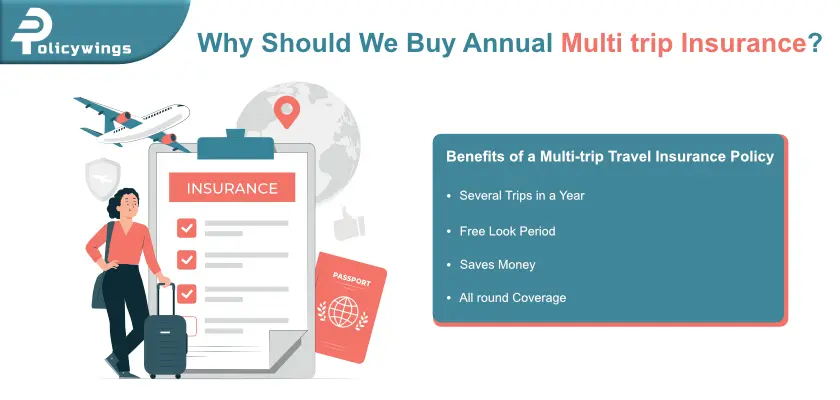
Cover all trips within a year, each typically up to 30–45 days. More cost-effective for travelers who make 3–4+ international trips annually. The annual plan's effective per-trip cost becomes very competitive for frequent flyers.
3. Student travel insurance
Specific plans for students studying abroad, often covering longer durations, educational institution-related benefits, and sometimes covering sponsor interruption (if the sponsor's income stops due to death or disability).
4. Senior citizen travel insurance
Higher medical cover, higher premiums. Essential for older travelers given the higher medical risk profile.
5. Corporate group travel
For companies whose employees travel internationally for business. Covers the group under one policy.
What Noida and Greater Noida Travelers Specifically Need
For the IT professional traveling to the US regularly on client visits: annual multi-trip plans with high US medical cover (USD 200,000+), medical evacuation, and trip interruption protection for prepaid non-refundable bookings.
For the family traveling to Europe on a tourist visa: Schengen-compliant plan with EUR 30,000+ medical cover (mandatory), trip cancellation for the total trip cost, and baggage cover.
For the retired couple visiting children in the UK or US: Senior citizen plans with maximum medical cover, pre-existing condition declaration and cover, and medical evacuation.
For the entrepreneur who travels to Dubai and Southeast Asia frequently: Annual multi-trip plan covering Gulf and Asia-Pacific, with trip cancellation and business travel extensions.
Policywings and Travel Insurance for NCR Travelers
At Policywings, we compare travel insurance across multiple insurers to match the plan to the specific trip — destination, duration, traveler profile, and prepaid booking value. For frequent travelers, we assess whether an annual plan or per-trip plans provide better value.
We also help with pre-existing condition declarations, which affect both plan eligibility and claim outcomes if not done correctly upfront.
To discuss travel insurance for an upcoming trip from Noida or Greater Noida, call +91-98111-67809.
Policywings Insurance Broking Pvt. Ltd. | IRDAI License No. DB 835 | A-57, 5th Floor, Sector-136, Noida | +91-98111-67809