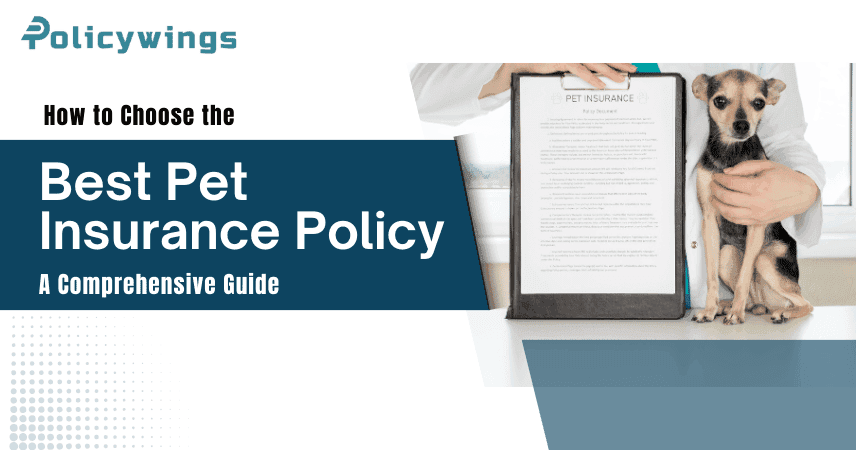
How to Choose the Best Pet Insurance Policy: A Comprehensive Guide
By Sagar Narang
How to Choose the Best Pet Insurance Policy: A Comprehensive Guide

Making sure your pets get medical attention involves buying a pet insurance policy as your financial backup plan. Getting veterinarian care and continuing medical care becomes easier when you choose a suitable insurance coverage for your pet.

Table of Contents

Toggle

Thanks to our status as pet owners, we work to give the best experience possible to our animals. Good pet owners take care of their pets by making sure they eat healthily and seeing their vets while living in safe conditions.

Medical emergencies force pet owners to pay large veterinary costs which strains their budget for caring for their beloved pets. A pet insurance policy steps in at this point to help.

In this blog, we will share all the necessary information to select the best pet insurance policy for your pet which includes various policy types, payment elements, plan evaluations, and specialist tips.

Understanding Pet Insurance

What is pet insurance?

When illness or injuries strike your pet there is a way to protect your finances: a Pet Insurance Policy helps you pay for help from the vet. Your pet insurance coverage helps you pay for a part of your pet’s medical costs so you can access top treatment at all times.

Under this type of coverage you pay the vet now then submit reimbursement claims to the insurance provider. When you select firms that offer direct billing services they pay your vet directly so you need to spend less out of your own pocket.

A Pet Insurance Policy pays for medical costs to ease the financial pressure of urgent medical procedures and continuous healthcare.

Your pet’s health depends on picking the best insurance plan and giving you comfort at the same time. Choosing between various policy options becomes difficult even though many plans exist.

How Does Pet Insurance Work?

Pet insurance typically follows these steps:

  1. Choose a plan: Select a policy based on your pet’s age, breed, and medical history.
  2. Pay monthly premiums. The amount depends on coverage, deductibles, and other factors.
  3. Visit the vet. Take your pet for treatment when needed.
  4. Submit a claim. Pay the bill and send a claim to the insurer.
  5. Get reimbursed: The insurer processes the claim and reimburses a percentage based on your policy.

Types of Pet Insurance Coverage

  • Accident-Only Plans protects against injury types including fractures, wounds, and accidental poisonings.
  • These plans protect against sickness, including infections, cancer and long-term medical illnesses.
  • These Plans Take Care of Both Medical Emergencies and Regular Healthcare Services
  • Wellness Plans Provide Basic Health Care, which Includes Regular Checkups Vaccinations and Dental Cleanings

Your pet insurance selection depends on your pet’s health needs alongside their breed risks and available finances.

Key Factors to Consider When Choosing a Pet Insurance Policy

/*! elementor - v3.22.0 - 26-06-2024 */
.elementor-widget-image{text-align:center}.elementor-widget-image a{display:inline-block}.elementor-widget-image a img[src$=".svg"]{width:48px}.elementor-widget-image img{vertical-align:middle;display:inline-block}

Key Factors to Consider When Choosing a Pet Insurance Policy

Coverage Options

  • Accident and Illness Coverage: Covers injuries, diseases, and hospital stays.
  • Chronic Conditions: Includes long-term illnesses like diabetes and arthritis.
  • Hereditary problems develop best in the following breeds.
  • Wellness & Preventive Care: Routine checkups, vaccinations, and dental cleanings.
  • Your insurance policy may include coverage for professional physical treatment sessions and related eastern therapies.The variety of pet insurance plans makes them different in their coverage range. Plans exist either for emergency care or for covering preventive medical needs. When evaluating policies, check for:
  • Before your purchase, check details about what benefits and exclusions are part of the policy.
  • These plans protect against sickness, including infections, cancer and long-term medical illnesses.
  • These Plans Take Care of Both Medical Emergencies and Regular Healthcare Services
  • Wellness Plans Provide Basic Health Care, which Includes Regular Checkups Vaccinations and Dental Cleanings

Your pet insurance selection depends on your pet’s health needs alongside their breed risks and available finances.

Cost and Premiums

The amount you pay for a debit insurance policy depends on different elements including:

  • The insurance rate increases according to a pet’s age and susceptibility to medical conditions while they belong to certain breed groups.
  • Plans that cover complete health issues usually demand more money than basic accident protection.
  • The prices of veterinary treatment in different areas determine insurance rates across regions.
  • Choosing higher deductible amounts decreases your premium charges but raises how much money you pay yourself before insurance help arrives.

To choose wisely assess different plans and decide which one gives you the best value for your money.

You Need to Contrast Policies to Find Affordable Insurance Plans That Offer Good Protection.

  • Look at different policies to identify affordable plans with quality protection.
  • Do not select the least expensive plan until you verify its benefits.
  • If you own multiple pets look for discounts that cover several pets at once.

Deductibles, Reimbursements, and Payout Limits

It is essential to know your personal costs versus what insurance will cover in detail.

  • Your insurance starts paying only after you pay your annual or incident-based deductible. Can be annual or per-incident.
  • Insurance companies pay a portion of the bill at the specified rates (70%, 80%, or 90%).
  • The insurer establishes the highest yearly and per-condition payment amounts they will provide.

Decide your reimbursement rate based on your finances, yet pick a level of insurance that offers good coverage.

**Example:
**If your pet’s surgery costs ₹50,000 and your plan has:

  • ₹5,000 deductible
  • 80% reimbursement rate
  • ₹1,00,000 annual payout limit

Your insurer will cover ₹36,000 (80% of ₹45,000 after deductible).

Waiting Periods and Exclusions

The cover needs to wait a defined span of time before taking effect in every insurance policy (14 days for sickness and 48 hours for injuries). Insurers also do not pay for:

  • Pre-existing conditions
  • Elective operations (e.g., tail docking, ear cropping)
  • Breeding-related costs

Tip: Insure your pet early to avoid pre-existing condition problems.

Reputation and Customer Reviews

Before choosing an insurer, consider:

  • Claim settlement ratio: claim processing speed.
  • Customer service: responsiveness and quality of support.
  • Online reviews: real feedback from other pet owners.

Tip: Choose a provider with good reviews and transparent claim processes

How to Research Providers:

  • Find customer reviews at reputable review websites.
  • Read social media feedback.
  • Ask other pet owners for business referrals.

Comparing Pet Insurance Providers

How to Research and Compare Plans

Use online comparison tools to evaluate different insurers. Check for:

  • Coverage inclusions & exclusions
  • Premium costs & deductible options
  • Reimbursement rates & payout limits

Policy Wings’ Recommendations

Policy Wings is a trusted source for pet insurance comparisons, providing insights into the best plans available. Visit Policy Wings for detailed comparisons.

Tips for Choosing the Right Policy for Your Pet

Match Coverage to Your Pet’s Needs

  • Young pets: wellness plans for preventive care.
  • Senior pets: Comprehensive plans covering chronic conditions.
  • Active pets: Accident coverage for injuries.

Consider Long-Term Costs

  • Cheap policies may not offer adequate coverage.
  • Look for policies with lifetime benefits rather than annual limits.

Read the Fine Print

  • Understand exclusions and waiting periods.
  • Look for hidden fees or restrictions on claims.

Latest Trends in Pet Insurance for 2025

  • AI systems help customers design insurance plans through personal health records of their pets.
  • Digital-First Insurance Helps Companies Process Claims Faster by Using Smartphone Applications
  • Mental Health Coverage for Pets – Support for anxiety and behavioral issues.
  • The company wants to focus more on preventing diseases to keep pets healthy in the long term.

Conclusion

Selecting an appropriate pet insurance policy helps you pay for your pet’s top-quality healthcare while preventing financial difficulties.

Evaluating different policies provides practical ways to select the best insurance coverage suited for your pet’s requirements.

The best way to find the best health insurance provider in India is through Policy Wings’ expert insights on high-rated healthcare plans.

Get proper pet insurance now to secure your pet’s health.

Share this article:

More on Pet Insurance

Hand-picked reads on pet insurance to help you decide with confidence.

All about Pet Insurance Growth in 2025Pet Insurance

All about Pet Insurance Growth in 2025

Introduction The insurance industry in India has conventionally orbited around human life, health, motor and property. But with evolving lifestyles and growing awareness there are new types that are moderately enhancing these factors. Under these changing insurance factors, pet insurance in India has initiated to apprehend the attention of both consumers and insurers. Till 2025 the sector is observing increasing growth which is managed by an increasing pet parenting population with higher expendable incomes and a cultural change regarding treating pets as essential members of the family. This development signifies the importance of a new niche market in the insurance market. Compared to health or motor insurance, pet insurance is transforming into a tool for financial security for unforeseen medical expenses which reflects wider global trends which are now exploring their place in the Indian community. Pet Parenting in India The magnification of pet insurance is related to the increasing number of households adopting pets. Over these ten years, urban India has noticed a rise in pet ownership especially in millennials and elementary families who regard pets as companions for their emotional comfort. Dogs and cats are the most common adopted household pets but fascination in Insuring exotic animals, birds and even high value breeds has also evolved. This change is not particular to wealthy households only because middle class families are also increasing expendable income with good approachable veterinary care and they are also investing in pet care. And due to this the demand for customised health protection has increased moderately. Understanding Pet Insurance Pet insurance works identically to health insurance for humans. Policies cover veterinary expenses related to illnesses, accidents, surgeries and sometimes preventive care like vaccinations. Certain products even have liability coverage for incidents when pets may cause injury, harm or damage. Insurers are still experimenting with policy customisation. Some offer limited coverage like accident only protection and others expand to comprehensive plans covering hospitalization, third party liability and loss or theft of pets as well. The idea of coverage is eventually extending as insurers collect more data and answer to customer demand. Rise of Pet Insurance The acknowledgement of pet insurance as one of India’s evolving insurance markets roots from wider socio economic and traditional changes. The rising humanization of pets where adoptive parents/owners see them as their children or companions and not just animals has made a requirement for professional healthcare, specialized food and preventive care. This corresponds to the universal trend where pet related sectors, from grooming to luxury accommodation have evolved excessively. Veterinary costs are increasing particularly in big cities where advanced diagnostic and surgical facilities are now accessible. Only one surgery or extended treatment can be very expensive which can create financial load for pet adoptive parents/owners. Pet insurance manages this gap by propagating risk and giving financial relief when required. Furthermore, insurers see pet insurance as a doorway to knock into new customer diversities. Numerous first time insurance buyers may initiate with pet coverage and eventually move to more conventional products like life or health insurance. For the insurance market this multi selling prospects makes pet insurance a desirable approach. Factors of Growth 1. Awareness campaigns and digital platforms are enlightening consumers about the accessibility and advantages of coverage. Pet owners are rapidly looking for financial tools to manage unpredicted medical costs. The involvement of technology cannot be ignored. Insurtech startups and digital first time insurers are making it simpler to buy, control, customise, manage and claim pet insurance policies. Apps and online platforms permit pet parents to upload documents as well as track vaccination schedules and process claims seamlessly. The extension of veterinary infrastructure has made modern treatment more approachable. From specialized clinics and pet hospitals with advanced equipment, the structure is more capable of managing demand for financial support by insurance. Evolving regulatory receptivity is motivating insurers to innovate. The Insurance Regulatory and Development Authority of India (IRDAI) has backed up new product enlargement in evolving insurance markets which creates space for pet insurance to enhance further. Complications in Pet Insurance Market 1. The first complexity is low awareness. In contrast to motor or health insurance the pet insurance is still in its initial stage and many pet adoptive parents/owners are unaware of its existence. Absence of systemised products. As insurers are still analysing the coverage terms and conditions which are distinctly broad making it complex for consumers to compare and select policies. Some do not include older pets, preexisting conditions or specific breeds which can lower the accessibility. Affordability is also a complication to be concerned about. As premiums are somewhat modest in contrast to human insurance, many middle class families still are reluctant to pay on extra financial products for pets. Convincing consumers for the long term value of coverage still is a hard task for insurers. The lack of strong claims data creates risks for insurers. With insufficient factual history companies battle with price policies. This creates a cautious approach lowering the extension of other comprehensive plans. Conclusion Pet insurance is not a distant concept anymore but a quickly evolving reality in 2025. It shows how Indian consumers are reanalysing priorities in health and financial security which extends care and wellbeing of their pets. Complications like awareness gaps, affordability and product standardization are still there, the perspective is clear. Pet insurance plays a critical role in the evolving insurance sector which gives both protection for pet owners and growth scenarios for insurers.

Written bySagar NarangPublished onSeptember 24, 2025

Explore: Claims & Support

Broaden your view with a quick read on claims & support.

Mediclaim Policy Renewal: What You Must Check Before RenewingClaim

Mediclaim Policy Renewal: What You Must Check Before Renewing

Introduction It might have happened to you or somebody you know that for years you had your mediclaim insurance policy and you were also paying regular premiums. Once time you made a claim and found out that certain benefits had lapsed. So frustrating, isn’t it? This is why it’s highly recommended that when you renew your mediclaim insurance, you must also make sure your coverage will continue to fit your needs. It’s super important to review your policy at the time of renewal, especially because medical costs are increasing. Let’s discuss what all do you need to check before renewing your mediclaim insurance in India so that you don’t miss changes in coverage or lose important benefits. What Makes Renewal So Important? Life is never the same. Sometimes situations change, sometimes lifestyle. You could develop a new illness, there could be an increase in medical prices or maybe the needs of your family grow than before. You must never renew your policy without reviewing it. When you pay attention at that time, you ensure having the right coverage when you actually need it. You can’t do much once you have bought the policy but renewals offer you a chance to: Upgrade coverage and match it with the rising medical costs. Add new riders or benefits to the policy that were not there before. Always renew on time so that waiting periods don’t restart. Protect your coverage by staying regular with your payments. After all, a careful renewal is a guarantee that your mediclaim insurance policy grows with your changing needs. What to Check Before Renewing Your Mediclaim Policy? Renewing your mediclaim insurance policy doesn’t just mean paying the premium on time but ensuring your coverage is enough for you when required. Let’s see what you should definitely check at the time of policy renewal: Coverage Amount (Sum Insured) In India, medical costs are rising every year and this is a point of concern. The insured amount you chose a few years ago is most possibly not enough today, especially if you’re in a metro city. Check if you need to increase the coverage while you are renewing. Waiting Periods for Pre-Existing Diseases When you keep renewing the policy, the waiting period for pre-existing conditions also keeps reducing and it’s a big benefit. At the time of payment, confirm whether the mediclaim insurance policy cover those diseases now. Room Rent Limit and Hospital Network Room rent limits or hospital tie-ups might be small factors but can affect your claim big time. If you want a private room but your policy allows only a shared room, you may have to pay yourself. It should also be checked if your preferred hospitals are a part of the insurer’s network. New Riders or Add-On Benefits Many insurers introduce new features for the convenience and benefits of the policyholders. People can always opt for the extras like critical illness riders, maternity cover etc. Of course, renewal time is the best to add these riders to your mediclaim insurance. Premium vs. Benefits The premium you’re paying should ideally justify the benefits you’re getting. It’s possible that there’s another plan from the same insurer or a different one that offers better coverage at a similar cost. At renewal, you upgrade your policy and it continues the same. No-Claim Bonus (NCB) Your insurer should also offer a no-claim bonus. Basically, many insurance companies increase your coverage amount for the year you don’t make a claim. Do keep this benefit in mind while renewing. Exclusions and Policy Updates Insurance companies also keep updating their terms. Every time you renew, go through the fine print to check what’s not included this year. It could be procedures like cosmetic surgeries or certain advanced treatments, so stay alert and informed. Grace Period for Renewal Renewal of mediclaim insurance in India has to be done before the due date. While insurance companies normally provide a grace period of 15–30 days for payments, you can’t make claims during this period. Also, missed renewal means waiting periods would restart and all the previous time has been wasted. Mistakes People Make During Renewal Renewing a mediclaim insurance policy isn’t limited to continuing the same plan. There are mistakes that so many people unknowingly make that either affect their coverage or claims. Just beware of these catches for a wise renewal: Not updating health details– Don’t forget to inform your insurer if you’ve developed a new illness or undergone surgery because hiding details can lead to your claim being rejected. Missing the due date– A late renewal means you will missout on your No Claim Bonus (NCB) and even a policy lapse. Ignoring changes in coverage– Sometimes insurance company change their terms, add new rider options or modify coverage so go through the fine print. Accepting higher premiums blindly– Many people pick up the first policy they see. Not comparing alternatives, they end up paying more. How to Save on Your Mediclaim Insurance? Time for renewal? It’s the perfect chance to make your mediclaim insurance in India more cost-effective while holding on to the benefits. All you need is a little planning for a reduced premium and improved coverage. Consider portability– If you find that another insurer is offering better benefits at the same cost, you can switch to it. Your continuity benefits will remain the same. Opt for long-term policies– Many insurers will also offer you discounts if you straightaway buy a 2–3 year mediclaim policy instead of renewing it every year. Adjust deductibles wisely– If your employer already provides health cover, choose a bigger deductible on your mediclaim to lower your premium. Compare online before renewal– You can also benefit from the market competition. You must check different plans so you can get the best value for your money. The Rising Need for Mediclaim Insurance in India The costs of healthcare in India are skyrocketing and there are hardly any signs of slowing down. Treatments for critical conditions like cancer,

Written byRahul NarangPublished onOctober 30, 2025
WFYP Full Form in Insurance: Meaning, Benefits and How It WorksClaim

WFYP Full Form in Insurance: Meaning, Benefits and How It Works

Introduction Upon buying insurance, you will notice different short forms in your policy documents that might confuse you. One of them is WFYP. It’s very commonly found in papers after the renewal of insurance premium for car or when you check the status of your health insurance premium payment. This short code often confuses people but it’s actually a very simple term to understand. Here, we will explain to you in the simplest way possible so that you know what you are agreeing to when buying a policy or learning your policy status. What Is WFYP Full Form in Insurance? So, WFYP is the short form for “Waiting For Your Premium.” This term in insurance is mainly used by insurance companies when your policy has been generated but the premium amount that you need to pay is still pending. Basically, it means that “Your policy is ready. Once you make the premium payment, we will activate it”. Your policy will not start till you make the payment. Why Does WFYP Matter? It is very important simply because the benefits of your policy will not start until the insurer receives the premium. Don’t just assume that you will be instantly protected after applying for a policy. WFYP clearly indicates that: Your application is accepted Your policy is all set and ready The company is only waiting for your premium so that your coverage can begin You can think of it like ordering food online. It will be prepared but you won’t get it without paying fir it. Why Insurers Use WFYP The real purpose behind using WFYP is used avoid confusion between the issued and an active policy because so many people make this mistake. Insurance companies use WFYP so that: Customers know that their payment is pending No claim is assumed without a premium receipt A record-based transparency is maintained Both parties know when the coverage starts When and Where You Usually See WFYP You can come across the term WFYP commonly during: Purchasing a new policy Renewing a car insurance policy Health insurance premium updates Porting to a new insurer Making changes in policy details Premium payments getting delayed It often shows up on: Policy dashboards SMS alerts Email updates App notifications Documents of proposal/issuance How WFYP Works: Step-by-Step Process Simply put, WFYP is the phase before insurance activation. Here’s how the actual WFYP process works in India: You select a plan: It could be car, health, life or any general insurance Submitting the application: Whether online or through an agent Reviewing your details: The insurer does KYC checks, run medical tests, does vehicle inspection, verifies documents etc. The policy gets approved: Your policy number is generated. Status changes to WFYP: The insurer is now waiting for your premium payment to be made. You pay the premium: Whether through UPI, card, net banking or cash Policy becomes immediately active: Payment is received and now claims are valid. What Happens If You Ignore a WFYP Status? WFYP is a clear message that your policy is not completed yet. You should not ignore it because: You won’t be having insurance protection Claims made will be rejected Your vehicle would be uninsured and this is illegal in India Health benefits don’t start till you make the payment Your policy may be cancelled if the premium is unpaid WFYP in Car Insurance For car owners, WFYP matters more than you think. It directly affects the insurance premium for car and also your legal safety. If your car insurance shows WFYP, it should be cleared immediately because otherwise: You can’t claim for any accidents or damages Third-party liability coverage won’t be active There may be fines if caught without active insurance If it’s a new car, the dealer may not release it without premium confirmation WFYP in Health Insurance Health insurance only works after the premium is paid. Thus, the health insurance premium must be cleared on time. If your policy shows WFYP, it means: Hospitalisation is not covered Cashless treatment is not allowed Waiting periods are not started Benefits for pre-existing disease are not active If overdue, renewal continuity can break Key Benefits of WFYP for Policyholders WFYP is not to be scared of; it’s actually helpful for the customers in many ways: Clear communication: With clear updates, you can instantly know where your policy stands. Prevents misunderstanding: There are no assumptions. You would know when the coverage starts and whether you are insured or not. Helps avoid claim disputes: All the details are clear before the policy gets active. Works as a reminder: Helps with timely premium payment so your policy doesn’t lapse. Tracks policy progress: You can know your policy is at which stage and can also be tracked step-by-step. How to Quickly Clear WFYP Just with a few minutes of attention, you can ensure uninterrupted protection. This is what you should do to avoid delays: Clear the premium payment immediately after the policy is approved Turn on updates (SMS/Email/WhatsApp) from your insurance company Enable auto-debit for car and health insurance, if possible Avoid waiting till the last day of the renewal Keep UPI/card details updated Keep the payment receipts with you for reference Conclusion WFYP simply means you must pay now to activate your coverage. Your insurance company has issued your policy, but your coverage starts once the premium is paid. Coming across a new term like WFYP, waiting for your premium, etc may bring multiple thoughts but aim to understand it. It will help you stay informed and you can avoid claim-related issues. If at all it feels overwhelming and you want a smoother experience, PolicyWings will guide you through the entire process. Let’s help you stay fully protected without stress.

Written bySagar NarangPublished onDecember 16, 2025