Get a Better Understanding of Electric Vehicle Insurance Rates
By Sagar Narang
Get a Better Understanding of Electric Vehicle Insurance Rates

Homepage  > Articles >

Get a Better Understanding of Electric Vehicle Insurance Rates

Table of Contents

Toggle

Get a Better Understanding of Electric Vehicle Insurance Rates

By Sagar Narang
Get a Better Understanding of Electric Vehicle Insurance Rates
  • July 8, 2024

How much does it cost for electric vehicle insurance? Or what are the electric vehicle insurance rates? These are the questions we get a lot from the general public.

Why not address it through this blog?

The way the automotive industry has experienced the sudden shift in sustainability and green mobility, there has been an increase in the adoption of electric vehicles (EVs).

Do you know, according to a report by BWAutoWorld, the EV market in India is booming and will continue to grow by approximately 47% every year from 2022 to 2027?

Since electric vehicles are taking the lead in the movement, people have started choosing electric cars. But they need help with picking the right insurance for their electric cars.

So, this blog is aimed to explain all things related to electric vehicle insurance, and electric vehicle insurance rates.

About Electric Car Insurance?

Electric car insurance in India gives coverage to electric cars and is different from two-wheeler and four-wheeler vehicle insurance.

The aforementioned insurance covers all the financial losses that you might suffer in case of any damage or emergency involving your electric car.

Also, an EV car insurance policy is made mandatory under The Motor Vehicle Act, of 1988.

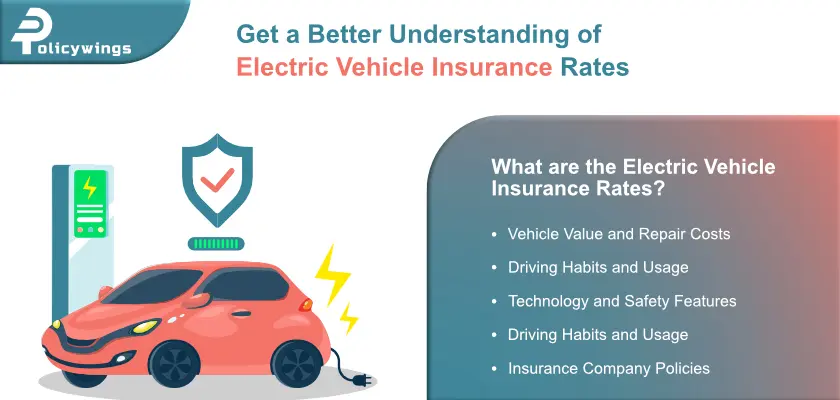
What are the Electric Vehicle Insurance Rates?

Electric vehicle (EV) insurance costs can vary based on several factors, but they are typically comparable to or slightly higher than insurance for traditional fuel vehicles. Here are some key factors influencing the cost of EV insurance:

Vehicle Value and Repair Costs

EV cars are expensive and so this leads to higher insurance premiums because the potential payout by the insurer is greater.
This also means that the cost to repair an EV can be higher due to specialized parts and labor. Battery replacement, for instance, can be expensive and affect premiums.

Driving Habits and Usage

EV owners often drive fewer miles compared to gasoline car owners, which can lead to discounts. Some insurers offer lower rates for EVs because they are often used for shorter, more frequent trips, which statistically involve lower risk.

Technology and Safety Features

EVs are equipped with advanced safety features and technology, which can sometimes lower insurance costs due to reduced accident risks. Many EVs receive high safety ratings, which can contribute to lower premiums.

Driving Habits and Usage

EV owners often drive fewer miles compared to gasoline car owners, which can lead to discounts. Some insurers offer lower rates for EVs because they are often used for shorter, more frequent trips, which statistically involve lower risk.

Insurance Company Policies

Some insurers specialize in EV coverage and may offer more competitive rates. Look for insurance companies offering discounts specifically for EVs or green vehicles.

Tips to Find a Low-Cost Insurance Policy for Electric Cars

  • Find the best rate by comparing quotes from multiple insurers.
  • Choosing a higher deductible will reduce the premium amount significantly. So increase deductible.
  • If you have a good driving record, drive a low-mileage vehicle, or the vehicle has safety features, you may be able to find discounts.
  • Some insurers offer policies that adjust premiums based on actual driving behavior, which can be beneficial for EV owners.

Thanks to awareness and technological advancements, electric cars are likely to become more affordable in the coming years.

However, today these cars are expensive with higher maintenance demands. So, if you are an electric car owner, and you must be looking for budget-friendly electric vehicle car insurance then PolicyWings can be of great help to you. Reach out to us today!

FAQs

What is electric vehicle insurance?

Electric vehicle insurance is coverage designed for electric cars, to protect against risks like accidents, theft, and damage. Sometimes it also includes specialized provisions for battery and charging equipment, addressing the unique needs of electric vehicle owners.

How insurance is calculated for electric cars?

The insurance amount for electric cars is calculated based on several factors like vehicle value, repair cost, battery type, driving history, and usage.

Is EV battery covered under insurance?

Yes, EV batteries are generally covered under electric vehicle insurance and are part of comprehensive and collision coverage. EV insurance policies cover damage, theft, and sometimes degradation, but specific terms vary by provider and policy, reflecting the high cost and critical nature of the battery.

What is the new EV policy in India in 2024?

The new EV policy in India for the year 2024 includes subsidies, tax benefits, and incentives for electric vehicle adoption. It aims to promote infrastructure development, including charging stations, and focuses on reducing emissions to encourage a shift towards sustainable transportation.

Does electric vehicle insurance cost more than insurance for petrol or diesel vehicles?

Yes, electric vehicle insurance is generally more costly than insurance for petrol or diesel vehicles due to higher repair and replacement costs, especially for batteries. However, premiums can be offset by incentives, lower running costs, and specialized EV insurance discounts.


Share this article:

More on Motor Insurance

Hand-picked reads on motor insurance to help you decide with confidence.

Fleet and Commercial Vehicle Insurance in India: A Comprehensive Guide for Logistics and Delivery CompaniesMotor Insurance

Fleet and Commercial Vehicle Insurance in India: A Comprehensive Guide for Logistics and Delivery Companies

Introduction Commercial Auto Insurance in India and Fleet Insurance are not just selective defences but they are also required by law and important parts of operational risk management for delivery and logistics companies. Every commercial vehicle is mandated by the Motor Vehicles Act of 1988 to have third party liability insurance at least. Businesses that have to manage a large number of vehicles must optimise or upgrade to cost and coverage with well structured fleet insurance adhering to legal requirements. Legal Regulatory Framework Motor Vehicles Act 1988 and Central Motor Vehicles Rules 1989: Every vehicle in usage should have third party liability insurance in accordance with Section 147 of the Motor Vehicles Act. Financial penalties, vehicle seizure and operation suspension are the most possible outcomes of noncompliance. For commercial transport operators, additional operational and compliance guidelines are provided by the Central Motor Vehicles Rules. Insurance Act 1938 and IRDAI Oversight: Insurance contracts are governed by the 1938 Insurance Act as amended and policy standards, premium computations and claim settlement procedures are governed by the Insurance Regulatory and Development Authority of India (IRDAI). Driver Licensing Requirements: According to recent Supreme Court decisions such as Mukund Dewangan v. Oriental Insurance Co. Ltd. (2017) owners of Light Motor Vehicle (LMV) licenses are permitted to drive specific commercial vehicles weighing less than 7,500 kg gross vehicle weight. Driving without the proper licence or in violation of the terms of the licence may result in repudiation of the claim and possible legal repercussions. Types of Commercial Vehicle Insurance A. Individual Commercial Vehicle Insurance This policy which is intended for small operators or single vehicle owners can be set up as follows: Third Party Liability: required coverage for third partie’s property damage, injury or death. Comprehensive Coverage: includes benefits for personal accidents, fire, natural disasters, theft and own damage protection. Fleet Insurance a single master policy with uniform terms that applies to several vehicles. Third Party Fleet Insurance satisfies large scale legal requirements. Own damage, passenger liability, legal defence expenses and personal accident coverage are all included in comprehensive fleet insurance. Benefits include centralised claims processing, simplified renewals, bulk premium discounts and fleet operations specific add ons. Important Policy Elements and Factors The maximum amount that can be claimed for own damage coverage is known as the Insured Declared Value (IDV) and it is established at the time the policy is purchased. Premium factors are determined by the type of vehicle (heavy or light), operational geography, age, usage, safety features and claims history. Preferential rates are frequently secured through fleet agreements. Add-on Covers: Logistics fleets benefit greatly from coverage for employee compensation, passenger liability, towing assistance, legal defence and rental replacement. Claims Settlement and Network Access: To minimise operational downtime, assess insurer performance in terms of claim settlement ratios, turnaround times and network workshop availability. Enforcement, Disputes and Consumer Rights Regulatory Supervision: IRDAI publishes legally binding guidelines regarding grievance redressal procedures, premium structures and coverage requirements. Consumer Forum and Motor Accident Claims Tribunal (MACT) adjudication Case law shows that insurers need to provide verifiable proof to support claim repudiations. Consumer commissions have overturned arbitrary denials such as accusations of overloading without evidence. Notable instances consist of: After excessive claim settlement delays a fleet owner was awarded INR 11.16 lakh in compensation plus INR 50,000 for mental suffering. Defending claims in the face of overloading accusations made by insurers in the absence of supporting documentation. Instructing insurers to cover 75% of IDV in cases of auto theft that take place just before a policy expires. Coverage Affected by Judicial Interpretations Validity of Licence: Driving a commercial vehicle without the proper transport licence was deemed a violation of policy in National Insurance Co. Ltd. v. Kusum Rai (2006). Subsequent decisions like Sunita & Ors v. United India Insurance Co. Ltd. and Mukund Dewangan (2017) have clarified the scope for LMV licence holders operating commercial vehicles under particular weight limits. In United India Insurance Co. Ltd. v. Sathish Kumar (2019) the case of Third Party vs. Comprehensive Cover reaffirmed that Act only policies do not provide coverage for occupants or pillion riders unless an additional premium is paid. Burden of Proof in Overloading Allegations: In cases where insurers were unable to provide reliable proof of policy violations, state consumer commissions have rendered decisions in favour of policyholders. Strategic Best Practices for Logistics Operators Centralise Insurance Management: For cost savings and administrative effectiveness and implement a single fleet policy. Maintain documentation attesting to the validity and appropriate category of each driver’s license in order to ensure license compliance. Keep Thorough Records: To reduce disagreements during claims, keep track of vehicle loads, maintenance logs and trip records. Engage Reputable Insurers: Choose insurers according to their industry reputation, service network and settlement efficiency. Include Main Add Ons: Customise policies to include coverages that can handle your operational/funtional risks like legal defence expenses and driver personal accident insurance. Keep Up with the Law: Keep an eye on important court rulings, IRDAI circulars and modifications to the Motor Vehicles Act. Conclusion Commercial auto insurance and fleet insurance are imporatant tools for business continuity in the logistics and delivery industry as well as legal requirements given India’s strict regulatory framework. Financial exposure and operational risks can be considerably decreased by properly structuring insurance policies which should be based on statutory compliance, judicial precedents and operational realities. An integrated legally compliant insurance strategy is both a competitive advantage and a compliance requirement for companies with sizable fleets of vehicles.

Written bySagar NarangPublished onSeptember 10, 2025
Car Insurance Price: Compare Premiums and Save on Your PolicyCar Insurance

Car Insurance Price: Compare Premiums and Save on Your Policy

Introduction Understanding how much car insurance costs in India and how insurers arrive at that car insurance price can save you money and stress. This guide explains what drives premiums, how to use a car insurance premium calculator, recent regulatory changes you must know and practical ways to compare and reduce your vehicle insurance cost India wide, written for Policywings readers who want fast, actionable clarity. What determines your car insurance premium Insurers price policies based on predictable risk drivers and choices you make when buying cover. Key factors are: Insured Declared Value (IDV): the vehicle’s current market value. Vehicle age, variant and make: luxury or performance cars cost more to insure. Cubic capacity/power and usage: private vs commercial usage affects third party rates. RTO location and registration details: premiums vary by city/zone. Claim history and No Claim Bonus (NCB): a claim free history lowers the own damage premium. Addons and deductibles: extras like zero depreciation or road side assistance raise premium; higher voluntary deductibles lower it. These factors are built into online car insurance premium calculators offered by insurers and aggregators to give instant estimates. Use them to run multiple scenarios (change IDV, addons, voluntary excess) so you can compare apples to apples. How third party and comprehensive premiums differ In India you buy either: Third party liability cover: mandatory by law; it covers legal liability for damage to others. Comprehensive (third party and own damage): includes repair/replacement for your vehicle (subject to deductibles and exclusions). Third-party premium rates are set by government notifications (in consultation with IRDAI) and often published as standardized rates for different engine sizes and vehicle classes. Own damage pricing is underwritten by insurers, so this is where most premium variation occurs. If you want the lowest car insurance price, compare the own damage component across insurers while ensuring the third party meets statutory requirements. Recent legal and regulatory updates every buyer should know Regulation in motor insurance has evolved to increase transparency and consumer protection. Important recent points: Multi year third party requirement for new vehicles: regulators and central government guidelines have promoted offering long term third party covers (for example three years for new private cars and five years for two wheelers) as standard options at purchase; own damage cover can be bought annually or as per insurer offerings. This affects upfront car insurance price calculations for new registrations. Standardisation of certain rules: IRDAI initiatives have pushed for uniform No Claim Bonus grids and clearer claim handling timelines which can reduce variability between insurers for those elements of premium calculation. Government-set third party tariffs: the Ministry of Road Transport and Highways (in consultation with IRDAI) notifies third party premium slabs; these remain outside an individual insurer’s pricing freedom. Expect changes when such notifications are updated, especially in response to inflation or claim trends. Recent judicial developments: courts have clarified aspects of who can claim under motor insurance and liability interpretation in accident cases; such rulings can influence claim outcomes and thereby affect insurer pricing over time. Keep an eye on major judgments that may broaden compensable heads or alter settlement practices. Use a premium calculator: the right way An effective car insurance premium calculator does more than spit a number. To get useful quotes: Enter exact vehicle make, model, variant and registration year (mismatches produce wrong IDV). Try at least three different IDV settings (market value, slightly lower, slightly higher) to see premium sensitivity. Toggle addons and voluntary deductibles to understand incremental cost for each benefit. Compare results from an insurer’s calculator and an aggregator: aggregators show side-by-side options quickly, insurers’ calculators sometimes reflect exclusive offers. Aggregators and insurer calculators are widely available and free; use them to shortlist 2 to 3 policies before buying. Practical tips to lower your vehicle insurance cost in India Maintaining and claiming judiciously: preserving NCB yields the single biggest discount on the own damage portion. Opt for higher voluntary deductibles if you can afford small repairs out of pocket. Avoid unnecessary addons, buy only what you will use. Fit approved antitheft devices and inform the insurer: some companies offer OD discounts. Bundle policies (home and car) with the same insurer if discounts apply. Compared at renewal: switching insurers can save money but ensure portability of NCB and check exclusions. Conclusion Confirm whether your new car needs a multi year third party policy at purchase and how that affects upfront cost. Verify IDV and inclusions for total loss/theft scenarios (ask how RC cancellation is handled in write offs). Check the fine print for sub limits (engine, electrical parts) and depreciation tables. Keep documents that prove past NCB and claim history: concealment can lead to claim repudiation. Getting the best car insurance price is mostly about comparison and a few smart choices: use premium calculators to model scenarios, understand the split between statutory third party costs and insurer priced own damage premiums and stay updated on regulatory changes that affect policy duration and claim handling. Policywings recommends running at least three online quotes and reading the policy wordings before you commit, small differences in addons and IDV can change your outlay significantly at the time of claim.

Written byRahul NarangPublished onNovember 28, 2025

You may also like: Claims & Support

Related guides from our claims & support desk.

Car Insurance Claim Process in India: Step-by-Step GuideClaim

Car Insurance Claim Process in India: Step-by-Step Guide

Whether it’s a little scratch or a big accident, a car insurance claim can save time, money and a lot of unnecessary stress. Sadly, filing a car insurance claim seems like a complicated task to a lot of people. They tend to get all blank when the situation arises. When in reality, it’s just a simple process. Once you know what to do and when, you will have your vehicle back on the road faster. Here, we will discuss how to get the most benefit of your insurance and what a well-handled claim actually looks like. Step 1: First, Ensure Safety Before you get straight to thinking about insurance, just make sure that everyone is safe around you. If possible, move the car to a safe spot Switch on hazard lights If anyone is injured, call for medical help There is nothing bigger than personal safety. The ‘claim’ part should come later. Step 2: Immediately Inform the Insurance Company Once you have the situation under control, it’s time to inform your insurer. Most insurers let you contact them through a customer care helpline, mobile app or website, writing an email or simply by visiting the branch. The earlier you inform, the better your insurer can guide you and speed up the process. Step 3: File an FIR In certain situations, you need to file an FIR. It could be after: The vehicle gets stolen There has been a major accident involving injury or death There is physical or property damage to third party If there are only minor damages, insurance providers usually don’t ask for an FIR. Still, you must always confirm with your provider. Step 4: Document the Damage A claim settlement can become much smoother if you have proper documentation in place. Your insurer may ask you to: Take clear photos or videos of the damaged vehicle Provide the date, time and location details of the incident Share basic details of what exactly happened This step is where you exchange proofs that help the insurer assess the claim accurately. Step 5: Vehicle Inspection by Surveyor After you have informed your insurer about the claim, the insurance company then appoints a surveyor who will come to inspect the vehicle. Depending on the insurer and severity of the damage, inspection may either happen physically at the garage or can even be done digitally through photos/video calls. A reliable motor insurance provider will make sure that inspections are timely done because delays can slow the entire claim process. Step 6: Repair at Network Garage or Preferred Garage You now have two options for the repair work: Cashless Claim (Network Garage): You can take your car to an authorised garage to fix it. Your Insurer settles the bill directly with the garage and you only have to pay for deductibles and non-covered items. Reimbursement Claim: You make an upfront payment for the repair bill and submit invoices and documents to the insurer. For this, you will be reimbursed later. This step becomes much easier when your policy is backed by an extensive network of garages. Step 7: Claim Settlement Once all repairs are done and documents are verified, you can relax. The insurer will settle the claim. The final amount depends on the coverage amount of the policy, deductibles and depreciation. If you have bumper to bumper insurance, depreciation is not a stress. An honest insurer will clearly explain if there will be any deductions. This really builds trust in the process. Step 8: Delivery of Vehicle After the settlement is done, the garage releases your vehicle and you can thoroughly inspect the repairs before taking your vehicle home. This is the stage when your claim is considered closed. How Add-Ons Affect the Claim Experience Add-ons are often very helpful and make your policy stronger. They can really make the claim process smoother for you. Let’s take examples: Zero depreciation (bumper to bumper insurance): Reduces depreciation deduction on parts Roadside assistance: Helps a lot during claims related to breakdowns Similarly, there are other add-ons. While they lightly increase premiums, they also simplify the claim experience. Common Reasons Why Claims Get Delayed or Rejected Here is the most important part. Some people complain that their claim wasn’t settled or that there have been issues. But this is because they made these mistakes: They were late for claim intimation Their documents were incorrect or incomplete Driving under the influence (eg. Alcohol) Policy had expired at the time of the incident A policy alone won’t solve things for you. While filing a claim, make sure you follow the right process whether you have the cheapest insurance for car or an expensive one. Why Claim Support Matters More Than Premium Premium is surely an important part of buying car insurance. However, the real test of a policy is during a claim. When claim support is strong, it means: Claim intimation is very easy Inspections are done faster Clear communication at each step Settlements are done on time Conclusion In India, the car insurance claim process is pretty structured. But your experience will largely depend on how informed you are about the process and how supportive your insurance provider. Keep in mind all the discussed steps because they will put you in control. Whenever something unexpected happens, you know what to do next. At the end, good car insurance not only protects your vehicle but also supports you in need.

Written bySagar NarangPublished onJanuary 23, 2026
WFYP Full Form in Insurance: Meaning, Benefits and How It WorksClaim

WFYP Full Form in Insurance: Meaning, Benefits and How It Works

Introduction Upon buying insurance, you will notice different short forms in your policy documents that might confuse you. One of them is WFYP. It’s very commonly found in papers after the renewal of insurance premium for car or when you check the status of your health insurance premium payment. This short code often confuses people but it’s actually a very simple term to understand. Here, we will explain to you in the simplest way possible so that you know what you are agreeing to when buying a policy or learning your policy status. What Is WFYP Full Form in Insurance? So, WFYP is the short form for “Waiting For Your Premium.” This term in insurance is mainly used by insurance companies when your policy has been generated but the premium amount that you need to pay is still pending. Basically, it means that “Your policy is ready. Once you make the premium payment, we will activate it”. Your policy will not start till you make the payment. Why Does WFYP Matter? It is very important simply because the benefits of your policy will not start until the insurer receives the premium. Don’t just assume that you will be instantly protected after applying for a policy. WFYP clearly indicates that: Your application is accepted Your policy is all set and ready The company is only waiting for your premium so that your coverage can begin You can think of it like ordering food online. It will be prepared but you won’t get it without paying fir it. Why Insurers Use WFYP The real purpose behind using WFYP is used avoid confusion between the issued and an active policy because so many people make this mistake. Insurance companies use WFYP so that: Customers know that their payment is pending No claim is assumed without a premium receipt A record-based transparency is maintained Both parties know when the coverage starts When and Where You Usually See WFYP You can come across the term WFYP commonly during: Purchasing a new policy Renewing a car insurance policy Health insurance premium updates Porting to a new insurer Making changes in policy details Premium payments getting delayed It often shows up on: Policy dashboards SMS alerts Email updates App notifications Documents of proposal/issuance How WFYP Works: Step-by-Step Process Simply put, WFYP is the phase before insurance activation. Here’s how the actual WFYP process works in India: You select a plan: It could be car, health, life or any general insurance Submitting the application: Whether online or through an agent Reviewing your details: The insurer does KYC checks, run medical tests, does vehicle inspection, verifies documents etc. The policy gets approved: Your policy number is generated. Status changes to WFYP: The insurer is now waiting for your premium payment to be made. You pay the premium: Whether through UPI, card, net banking or cash Policy becomes immediately active: Payment is received and now claims are valid. What Happens If You Ignore a WFYP Status? WFYP is a clear message that your policy is not completed yet. You should not ignore it because: You won’t be having insurance protection Claims made will be rejected Your vehicle would be uninsured and this is illegal in India Health benefits don’t start till you make the payment Your policy may be cancelled if the premium is unpaid WFYP in Car Insurance For car owners, WFYP matters more than you think. It directly affects the insurance premium for car and also your legal safety. If your car insurance shows WFYP, it should be cleared immediately because otherwise: You can’t claim for any accidents or damages Third-party liability coverage won’t be active There may be fines if caught without active insurance If it’s a new car, the dealer may not release it without premium confirmation WFYP in Health Insurance Health insurance only works after the premium is paid. Thus, the health insurance premium must be cleared on time. If your policy shows WFYP, it means: Hospitalisation is not covered Cashless treatment is not allowed Waiting periods are not started Benefits for pre-existing disease are not active If overdue, renewal continuity can break Key Benefits of WFYP for Policyholders WFYP is not to be scared of; it’s actually helpful for the customers in many ways: Clear communication: With clear updates, you can instantly know where your policy stands. Prevents misunderstanding: There are no assumptions. You would know when the coverage starts and whether you are insured or not. Helps avoid claim disputes: All the details are clear before the policy gets active. Works as a reminder: Helps with timely premium payment so your policy doesn’t lapse. Tracks policy progress: You can know your policy is at which stage and can also be tracked step-by-step. How to Quickly Clear WFYP Just with a few minutes of attention, you can ensure uninterrupted protection. This is what you should do to avoid delays: Clear the premium payment immediately after the policy is approved Turn on updates (SMS/Email/WhatsApp) from your insurance company Enable auto-debit for car and health insurance, if possible Avoid waiting till the last day of the renewal Keep UPI/card details updated Keep the payment receipts with you for reference Conclusion WFYP simply means you must pay now to activate your coverage. Your insurance company has issued your policy, but your coverage starts once the premium is paid. Coming across a new term like WFYP, waiting for your premium, etc may bring multiple thoughts but aim to understand it. It will help you stay informed and you can avoid claim-related issues. If at all it feels overwhelming and you want a smoother experience, PolicyWings will guide you through the entire process. Let’s help you stay fully protected without stress.

Written bySagar NarangPublished onDecember 16, 2025

Explore: Business Insurance

Broaden your view with a quick read on business insurance.

Fire & Theft Protection: Is Your Commercial Property Fully Covered?Commercial Property Insurance

Fire & Theft Protection: Is Your Commercial Property Fully Covered?

Introdcution Your workspace is your safe space. You spend years building it and invest your money and heart in maintaining it. But what if one night there’s a spark in faulty wiring that sets off a fire? Or there’s a huge theft that wipes away your valuable stock? Such risks are always there and cause a big loss to businesses every year. This is where commercial property insurance will protect you from the unexpected. Now the question here is: Is your precious property really covered against fire and theft or are there any loopholes that might surprise you when you need this protection most? Why Fire & Theft Coverage Matters so Much? Profits, sales and growth keep the energy of running the business alive but you also have to protect what you already have, right? Two of the most common risks that most businesses face are fires and theft. You could be operating a small coffee shop or a big factory, the threats remain the same. Fire Risks: There could be some electrical faults, short circuits, accidents in the kitchen or even natural disasters. It all can cause fires that not only damage the building but also destroy the assets in the facility. Theft Risks: Robbers and burglars can break in and take away your stock and other stuff. This leads to loss of valuable machinery, office equipment or even inventory. Property insurance helps you recover from all such losses that can otherwise be almost impossible. Insurance will make sure that you don’t have to start all over again after a disaster. What Does Commercial Property Insurance Cover? If you have a good commercial property insurance plan, it will be a solid financial shield. Depending on the policy, it will cover damages caused by fire, theft, destruction and natural disasters. Usually, this is what it includes: Protection of Building: It covers the whole structure, including the walls, roof, floors and installations. Coverage of the Contents: All the office furniture, machinery, equipment, computers, inventory and other assets in the space are protected. Fire Damage: You will be reimbursed for losses that are caused by fire accidents, explosions or lightning. Theft or Burglary Losses: If the items are stolen or any damage is caused by forced entry during a burglary, it will be covered. Business Interruption (Optional): Some commercial property insurance plans offer an additional benefit of covering the loss of income in case your business has to temporarily shut down after a fire or theft. Common Shortfalls in Fire & Theft Protection Many businesses make the mistake of assuming that having commercial property insurance means they’re fully covered. However, you must know that all policies are not the same. Some may even carry their limitations that can cost you later like: Underinsured Property: If the coverage value is less than the actual worth of your property and assets in it, naturally, you’ll get less money than your claim. Exclusions in Theft Coverage: While some policies do cover burglary, there’s no coverage for employee theft. Normally, the cover is only for a clear theft or there was forced entry into the premises. Old Equipment or Furniture: Some insurance providers don’t provide any insurance for outdated machinery or would give only partial value for these old assets. Temporary Assets: If you transfer your stock or equipment to a different place and it gets damaged in a fire there, it might not be covered without any specific mention. It’s very important to understand these gaps to get assured protection from your commercial property insurance plan. How to Ensure Your Property Insurance is Fully Covered from Fire & Theft We have some simple steps that business owner should follow for assured safety: Review Your Policy Regularly The needs of a business change with time. There could be purchases of new equipment, space may be renovated or operations could expand. Your property insurance policy should also match your current situation. Understand the Exclusions The fine print has all the details, so read it carefully. There may always be some exclusions in commercial property insurance plans like if fire is caused due to negligence and it causes damage or if employees steal something. With the right information, you can add useful riders or additional coverage. Go for an Adequate Sum Insured Going for a lower coverage amount to save on premiums is not right. If your policy covers only ₹30 lakh but assets are worth ₹70 lakhs, then it’s pointless. You’ll face huge losses in both fire or theft situations. Ask About Business Interruption Cover Being covered for fire or theft damages is good but will you also get help for the days your business is not able to operate because of the damages? With business interruption cover, you continue having an income during downtime. Compare Multiple Commercial Property Insurance Plans There are many policies that you can choose from. It’s good to compare different commercial property insurance plans to find which one offers your business the best fire and theft coverage. Example of Fire & Theft Coverage Saving Businesses: A sudden electrical fire happened in a popular cafe that destroyed all the furniture and kitchen equipment. But since the owner has the right property insurance, he got reimbursement for repair work and replacement of things. Hence, the cafe could reopen in just a few weeks. Tips to Reduce Risks of Fire & Theft While you can get the necessary financial protection from insurance, prevention is always better. These simple steps can help: Install fire alarms and sprinklers to control the situation. Regularly maintain electrical wiring and equipment. CCTV cameras and security systems should be used to keep an eye. Conduct background checks of the employees before hiring. Secure all points of entry and exit to reduce the chances of theft. Besides providing the protection, these measures also reduce the premium for your commercial property insurance. Why Businesses Often Overlook Full Coverage Insurance is an investment. However, many small and medium businesses avoid

Written byRahul NarangPublished onOctober 16, 2025
Is Your Business Uninsured? Here’s How to Find OutBusiness Insurance

Is Your Business Uninsured? Here’s How to Find Out

Introduction Underinsurance in businesses is one of the most common yet overlooked financial risks faced by companies in India. If coverage limits, terms or valuations don’t align with actual risk, a company may have insurance policies in place but still be at risk. To find these gaps, match coverage to operational realities and make sure your policies actually protect you in the event of a claim, it is imperative to conduct a business insurance audit in India. Knowing Underinsurance: It’s Not Just About Low Coverage When the scope of coverage or sum insured is insufficient to cover the actual loss incurred, underinsurance occurs. It usually results from out of date asset valuations, operational changes that aren’t taken into account or a lack of specific coverage for emerging risks in India. It is the insured’s responsibility to declare accurate sums insured and maintain policies up to date; the Insurance Act of 1938 and IRDAI regulations do not automatically prevent underinsurance. In reality, a lot of claims are lowered under the “average clause”, which states that if assets are undervalued, compensation will be lowered proportionately. The Effects of Underinsurance on Indian Businesses Underinsurance can have serious financial repercussions. Due to proportional settlement rules, the insurer may only pay half of the amount if, for instance, your factory’s machinery is worth ₹10 crore but is only insured for ₹5 crore and you sustain a ₹2 crore loss. This strategy has been supported by Indian courts. The average clause was upheld by the court in United India Insurance Co. Ltd. v. Pushpalaya Printers because the insured had assets that were undervalued despite their belief that they were “adequately” insured. Step 1: Conduct a Comprehensive Business Insurance Audit In a business insurance audit in India, all policies of property, liability, cyber, marine, directors and officers (D&O), employee benefits and sector specific coverage are methodically reviewed. Through this process, you can make sure that the policy terms, coverage scopes and sums insured reflect the current state of your business. An audit ought to confirm: Precise asset appraisal (at replacement or reinstatement value) Revised revenue numbers for business interruption insurance Coverage types’ applicability in light of changing risk exposures Step 2: Reassess Asset Valuations Annually Your insurance limits may soon become out of date due to capital investments, inflation and currency fluctuations. Undervaluing assets may be considered misrepresentation since IRDAI requires a fair presentation of risk. Annual valuations help keep your insurance in line with replacement costs, especially for inventory, plant and machinery. Step 3: Review Policy Exclusions and Limitations Underinsurance is caused by both omitted exclusions and inadequate sums insured. Many Indian companies find out too late that their policies do not cover losses from certain risks, such as floods or cyberattacks. Any missing extensions should be found during a policy review, including: Property coverage for earthquakes and cyclones Protection against ransomware and data breaches for online threats Coverage for supply chain interruptions in manufacturing or logistics companies Step 4: Align Coverage with Operational Changes New products, enlarged service areas or new locations all bring new risks as businesses change. These modifications must be reported to the insurer in accordance with the Indian insurance law’s recognition of the principle of utmost good faith. As demonstrated in Satwant Kaur Sandhu v. New India Assurance Co. Ltd., where failure to disclose material facts voids the policy, failure to do so may result in claims being denied. Step 5: Evaluate Business Interruption Coverage Businesses are especially vulnerable to underinsurance when it comes to business interruption (BI) coverage. Since many policies are predicated on antiquated revenue estimates, businesses are left vulnerable during protracted outages. Accurate BI coverage in India ought to show: Present yearly turnover Expected expansion Reasonable turnaround times for operations Step 6: Examine adherence to contractual and statutory insurance requirements Certain industries are mandated to have insurance under the Indian Acts and Laws. For example the Public Liability Insurance Act of 1991 requires specific third party liability coverage for industries that are disastrous, hazardous or catastrophic and the Motor Vehicles Act requires minimum liability coverage for carriers. In order to avoid penalties and ensure that contracts with clients, landlords or lenders are upheld a business insurance audit ensures that all of these legal requirements and compliances are met. Step 7: Track Claims History and Adjust Accordingly Examine whether the terms and coverage limits were adequate if you have had claims within the last 12 months. Trends in claims that are rejected or only partially resolved could point to ongoing underinsurance or misaligned policies. Future disputes are avoided through proactive adjustments. Legal Principles Reinforcing the Need to Avoid Underinsurance When assets are undervalued, Indian courts have consistently upheld insurer’s rights to apply proportional settlement. They also reaffirm the insured’s obligation to accurately and completely disclose risk. Thus, underinsurance can result in disagreements that escalate into expensive litigation in addition to lowering claim payouts. Furthermore, companies still have an obligation to maintain sufficient coverage even though insurers are required by the IRDAI’s Protection of Policyholder’s Interests Regulations to provide clear explanations of policy terms. How to Maintain Adequate Coverage Year Round Avoiding underinsurance is a continuous process. It calls for: Every year, all policies must be audited Revaluations of assets in accordance with market replacement costs When operations change, regular risk assessments are conducted. Speaking with brokers or legal counsel who are knowledgeable about the risks unique to a given industry Businesses can make sure they maintain coverage that actually protects them by instituting these measures. Conclusion In businesses, underinsurance is frequently an undetectable risk until calamity occurs. Businesses can guard against operational failures, legal issues and financial gaps by putting in place a structured business insurance audit India. The most resilient companies view insurance audits as an essential component of strategic risk management rather than as a compliance exercise. In a market that is becoming more unpredictable, this strategy makes sure that coverage changes with the company to safeguard assets, income and reputation.

Written byRahul NarangPublished onNovember 20, 2025
Why Your Business Needs Commercial Property Insurance?Commercial Property Insurance

Why Your Business Needs Commercial Property Insurance?

Introduction The best thing about running a business is making profits but it’s equally important to protect what you’ve built. You spend years setting up your workplace, what if it gets all damaged overnight by a fire accident or maybe an earthquake? It’s not even easy to think of such a situation. This is why you need commercial property insurance. Sadly, many businesses underestimate the importance of property insurance, because they keep thinking that nothing so bad will happen. But this is life. Risks are unpredictable. One incident and it may cost you lakhs or even crores. Only with the right coverage through commercial property insurance plans you can protect your hard-earned investment. We are here to help you understand why every business, regardless of size, must have commercial property insurance. What is Commercial Property Insurance? It’s a type of insurance that protects your valuable business property against damaging risks like fire, theft, natural disasters or anything that causes loss of property. Not just the building, it also covers the assets inside it like equipment, tools, machinery, furniture, raw materials, finished goods etc Let’s suppose a fire accident happens in your office and it damages your building and destroys your equipment. Now, commercial property insurance will cover the cost of repairs and replacements. Yes, the load will not fall on your pocket. Without insurance, all your savings will go into fixing your office or you might even have to take loans. Why is Property Insurance so Important for Businesses? It doesn’t matter if you own a small shop or a huge factory; it’s your business and your operations rely on it. Damage to the property directly disrupts your business and impacts your income. Property insurance is essential because: It protects all your physical assets in the workspace. It makes sure the business continues even after an accident. It provides the much-needed financial stability during tough times. It doesn’t let your working capital or savings be wiped out for repairs or replacements. In short, without property insurance, all operations will come to a halt after a single bad event. What Do Commercial Property Insurance Plans Cover? While all insurance providers offer different coverage, here’s what most commercial property insurance plans protect from: Buildings and Structures– Workspaces like corporate offices, large warehouses, showrooms and factories. Furniture and Fixtures– All your desks, chairs, shelves and other furniture that’s set up. Machinery and Equipment– Tools & equipment used for manufacturing, heavy machinery and even computers/laptops. Stock and Inventory– Raw materials and finished goods present in the facility and even the goods in transit. Loss of Rent/Income– In case your property becomes unusable due to the damage caused. Natural Disasters– Damaging disasters like heavy floods, earthquakes, storms, large cyclones etc. Man-Made Risks– If there’s fire, theft, riots, strikes or other intentional damage. This is why commercial property insurance plans are adaptable to the different industries it is being taken for. Benefits of Commercial Property Insurance These are the top reasons that convince you to get your property insured: Protection Against Financial Loss: If a disaster, whether natural or man-made, can cause huge financial damage. With insurance in place, there’s no need to pay for any repairs and replacements from your pocket. Business Continuity: When operations are disrupted, it can lead to loss of income. Thankfully, many policies cover the loss of income, thereby making sure that your cash flow isn’t completely stopped. Peace of Mind: The assurance that your property and assets are protected lets you focus on growth with a relaxed mind and you don’t stay worried about unexpected situations. Covers More Than Just Buildings: Remember that insurance isn’t limited to just the physical building. It also covers your finished and raw stock, machinery, furniture and sometimes even electronic data (add-on benefit). Improves Business Credibility: Insured businesses are preferred by banks, investors, and even clients because they seem more stable and reliable. If you have property insurance, it means you take your risks seriously. Who Needs Commercial Property Insurance? Honestly, any business that owns or rents physical space should consider getting it. They could be: Retail Stores & Showrooms– To protect their inventory and display stock. Warehouses– To secure all the goods and raw materials stored in the facility. Manufacturers– They need it to protect their machinery and production equipment. IT Companies– It covers all the office equipment like laptops, servers etc. Restaurants & Hotels– Insurance ensure the kitchens, furniture, interiors and related assets are secure. Not just these sectors, even small businesses like salons, coaching centers and workshops can go for commercial property insurance plans, because risks are there for businesses of all sizes. Common Risks Businesses Face Without Insurance Not having commercial property insurance means your business is exposed to some serious risks like: You have to pay for heavy repair or replacement costs from your own pocket. Customers may go to another business because of operational shutdowns. Risk of bankruptcy, especially if the damage is not easy to recover from. You might struggle with banks or investors due to a lack of credibility now. One accident, maybe due to fire, flood or a major robbery, can affect your years of effort if there’s no insurance. How to Choose the Right Commercial Property Insurance Plan There are a few things that you must keep in mind when comparing commercial property insurance plans: Assess Your Assets– Make a detailed and proper list of all the property, stock and equipment you want to secure. Understand What’s Included and What’s Not– Remember that policies may not cover all kinds of damages. Check Add-ons– You can opt for extra benefits like electronic equipment cover, goods in transit or natural disaster extensions for stronger coverage. Compare Premiums vs. Coverage– Buying the cheapest is not the solution. Focus on value for money. Reassess Regularly– Do update your coverage as your business grows so you’re not underinsured. For example, a sudden electrical fire happens in a small textile factory that damages machines worth ₹37 lakh.

Written bySagar NarangPublished onNovember 17, 2025