Why Pet Insurance for Dogs? Explore the Benefits
By Sagar Narang
Why Pet Insurance for Dogs? Explore the Benefits

Homepage  > Articles >

Why Pet Insurance for Dogs? Explore the Benefits

Table of Contents

Toggle

Why Pet Insurance for Dogs? Explore the Benefits

By Sagar Narang
Why Pet Insurance for Dogs? Explore the Benefits
  • May 28, 2024

Pets are precious members of our family and when we can take health insurance for our family members, why not also for pets? 

Pets enter our lives and soon they become a part of our family. 

And just like any other family member, they also require proper care. But sometimes unexpected vet bills can become a financial burden. 

To tackle the financial burdens of our family members, we take family health insurance. However, in the case of our beloved pets, there is pet insurance. 

If you have a pet, I’ll suggest that you read this article till the end, to read each and every detail about pet insurance and how you can get them. 

Let’s get started!

What is Pet Insurance?

Pet Insurance is designed to provide financial safety to pet owners by providing their furry family members the medical aid they need, without emptying one’s wallet. 

As we said earlier, pet health insurance for dogs works similarly to human health insurance. 

While getting a pet insurance plan for dogs, you have to pay a monthly premium to your insurance provider in exchange for coverage for all the medical expenses your pet incurs. 

Average Veterinary Expenses

The average vet’s expenses include: 

Accidents & Injuries

The insurance covers all the treatment costs associated with accidents, bites, or any unforeseen injuries. 

Illness

Pet insurance will also offer financial assistance in case any illness is diagnosed or if there is any treatment going on related to the various types of illnesses a pet develops. 

Surgery

Pet insurance helps offset the high costs of surgeries your dog might need, from cruciate ligament repair to emergency procedures.

Hospitalisation

Having pet insurance also covers the cost of hospitalization when your dog is undergoing treatment and recovery. 

Types of Coverage

Now that we have mentioned, a few significant vet expenses. It’s quite evident to also discuss a range of coverage options. 

If you get an idea of the points covered in pet insurance, you will be able to choose the best pet insurance for dogs. 

Some of the common types of coverage offered by organizations under pet health insurance for dogs are:

Accident-only plans

Provide basic coverage for accidents and injuries of pets.

Accident and illness plans

Offer broader coverage for accidents, illnesses, and surgeries.

Wellness plans

Cover preventive care costs like vaccinations and routine checkups.

Now, these coverage options can vary based on the insurer. Also, the cost of dog pet insurance will vary, depending on several factors, like the breed of your dog, age, coverage level, and deductibles. 

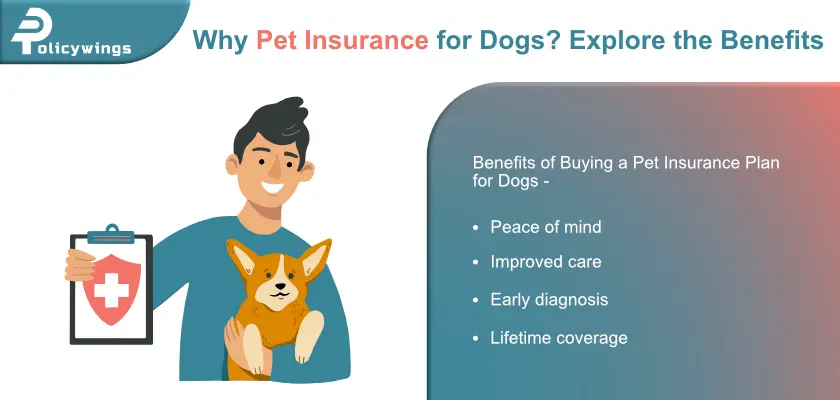
Benefits of Buying a Pet Insurance Plan for Dogs

There are many benefits of having pet insurance for dogs other than just buying pet health insurance. Some of these benefits include:

  1. Knowing that you have a financial backup for unexpected vet bills allows you to focus on your dog’s recovery without worrying about the cost. In this way, pet parents will have peace of mind.
    Imagine your dog swallowing a toy and needing surgery. With pet insurance, you can focus on their health without worrying about the vet bill.
  2. Pet insurance for dogs will literally empower you as an owner so that you can make informed decisions about your furry friend’s healthcare without any financial constraints.
    Therefore, if your dog needs expensive diagnostic tests or any kind of specialized treatment, then pet insurance will come as a great help and help you provide improved care for your pets.
  3. Some pet insurance for dogs also provides coverage for diagnostic tests. This can be very useful in the early diagnosis of any disease, giving you extra time for treatment. Nonetheless, diagnosing a disease at an early stage means a better chance of successful treatment and lower overall costs.
  4. Some plans also offer coverage for the entire dog’s life, providing you with long-term financial security. So, you can plan your pet’s future healthcare with more certainty.

To Conclude,

By investing in pet insurance for dogs, you are literally making a commitment to secure the health and well-being of your beloved pet. 

There are many pet insurance providers with different plans. However, it’s in your hands to select the right plan, and that needs your careful consideration. 

With only proper research and planning, you can find a pet insurance plan that will give you peace of mind and ensure that your dog receives the best possible care throughout life. 

However, if you want to avoid all the research work, then PolicyWings can be of great help to you.

On policyWings, we bring all the best pet insurance for dogs available in the market, all under one roof. All you have to do is compare the premiums, and our team can guide you on the same. 

Visit our website or reach out to us directly, and our team will help you as per your requirements. 

Thank you for reading.

FAQs

What is not covered by Petplan?

Some of the exclusions under Petplan are-

  • No coverage during the waiting period.
  • Pre-existing medical condition.
  • Pregnancy/birth (excluded in some policies)
  • Bilateral Disease
  • Breed exclusion

Is pet insurance worth it?

If you have a pet, it is always worth getting pet insurance. In the event that your pet becomes ill or is hurt, pet insurance will cover medical expenses. Pet insurance for dogs and cats is therefore worthwhile for your pet and wallet.

What is the age limit for dogs in Petplan?

A pet insurance generally covers dogs and cats of all ages, from puppies to seniors. Nevertheless, the minimum age to sign up for a new policy may differ based on the particular plan and breed of the dog. Check the age restriction points while buying the pet insurance policy.

Is pet insurance cheaper for 2 dogs?

Yes, some pet insurance premiums for two dogs might be slightly cheaper than insuring each dog individually. Some insurance providers offer multi-pet discounts, making it a little less expensive to insure 2 pets under the same policy.

What age is best to get pet insurance?

The ideal age to get pet insurance is when your pet is young and healthy, typically around 6-8 weeks old.


Share this article:

More on Pet Insurance

Hand-picked reads on pet insurance to help you decide with confidence.

All about Pet Insurance Growth in 2025Pet Insurance

All about Pet Insurance Growth in 2025

Introduction The insurance industry in India has conventionally orbited around human life, health, motor and property. But with evolving lifestyles and growing awareness there are new types that are moderately enhancing these factors. Under these changing insurance factors, pet insurance in India has initiated to apprehend the attention of both consumers and insurers. Till 2025 the sector is observing increasing growth which is managed by an increasing pet parenting population with higher expendable incomes and a cultural change regarding treating pets as essential members of the family. This development signifies the importance of a new niche market in the insurance market. Compared to health or motor insurance, pet insurance is transforming into a tool for financial security for unforeseen medical expenses which reflects wider global trends which are now exploring their place in the Indian community. Pet Parenting in India The magnification of pet insurance is related to the increasing number of households adopting pets. Over these ten years, urban India has noticed a rise in pet ownership especially in millennials and elementary families who regard pets as companions for their emotional comfort. Dogs and cats are the most common adopted household pets but fascination in Insuring exotic animals, birds and even high value breeds has also evolved. This change is not particular to wealthy households only because middle class families are also increasing expendable income with good approachable veterinary care and they are also investing in pet care. And due to this the demand for customised health protection has increased moderately. Understanding Pet Insurance Pet insurance works identically to health insurance for humans. Policies cover veterinary expenses related to illnesses, accidents, surgeries and sometimes preventive care like vaccinations. Certain products even have liability coverage for incidents when pets may cause injury, harm or damage. Insurers are still experimenting with policy customisation. Some offer limited coverage like accident only protection and others expand to comprehensive plans covering hospitalization, third party liability and loss or theft of pets as well. The idea of coverage is eventually extending as insurers collect more data and answer to customer demand. Rise of Pet Insurance The acknowledgement of pet insurance as one of India’s evolving insurance markets roots from wider socio economic and traditional changes. The rising humanization of pets where adoptive parents/owners see them as their children or companions and not just animals has made a requirement for professional healthcare, specialized food and preventive care. This corresponds to the universal trend where pet related sectors, from grooming to luxury accommodation have evolved excessively. Veterinary costs are increasing particularly in big cities where advanced diagnostic and surgical facilities are now accessible. Only one surgery or extended treatment can be very expensive which can create financial load for pet adoptive parents/owners. Pet insurance manages this gap by propagating risk and giving financial relief when required. Furthermore, insurers see pet insurance as a doorway to knock into new customer diversities. Numerous first time insurance buyers may initiate with pet coverage and eventually move to more conventional products like life or health insurance. For the insurance market this multi selling prospects makes pet insurance a desirable approach. Factors of Growth 1. Awareness campaigns and digital platforms are enlightening consumers about the accessibility and advantages of coverage. Pet owners are rapidly looking for financial tools to manage unpredicted medical costs. The involvement of technology cannot be ignored. Insurtech startups and digital first time insurers are making it simpler to buy, control, customise, manage and claim pet insurance policies. Apps and online platforms permit pet parents to upload documents as well as track vaccination schedules and process claims seamlessly. The extension of veterinary infrastructure has made modern treatment more approachable. From specialized clinics and pet hospitals with advanced equipment, the structure is more capable of managing demand for financial support by insurance. Evolving regulatory receptivity is motivating insurers to innovate. The Insurance Regulatory and Development Authority of India (IRDAI) has backed up new product enlargement in evolving insurance markets which creates space for pet insurance to enhance further. Complications in Pet Insurance Market 1. The first complexity is low awareness. In contrast to motor or health insurance the pet insurance is still in its initial stage and many pet adoptive parents/owners are unaware of its existence. Absence of systemised products. As insurers are still analysing the coverage terms and conditions which are distinctly broad making it complex for consumers to compare and select policies. Some do not include older pets, preexisting conditions or specific breeds which can lower the accessibility. Affordability is also a complication to be concerned about. As premiums are somewhat modest in contrast to human insurance, many middle class families still are reluctant to pay on extra financial products for pets. Convincing consumers for the long term value of coverage still is a hard task for insurers. The lack of strong claims data creates risks for insurers. With insufficient factual history companies battle with price policies. This creates a cautious approach lowering the extension of other comprehensive plans. Conclusion Pet insurance is not a distant concept anymore but a quickly evolving reality in 2025. It shows how Indian consumers are reanalysing priorities in health and financial security which extends care and wellbeing of their pets. Complications like awareness gaps, affordability and product standardization are still there, the perspective is clear. Pet insurance plays a critical role in the evolving insurance sector which gives both protection for pet owners and growth scenarios for insurers.

Written bySagar NarangPublished onSeptember 24, 2025

You may also like: Health Insurance

Related guides from our health insurance desk.

Best Family Health Insurance Plans for Indian Households in 2026Health Insurance

Best Family Health Insurance Plans for Indian Households in 2026

Introduction Everyone deserves healthcare but sadly, with the medical expenses rising so fast in India, not everyone can afford it as and when needed. This makes it super important to have the right health insurance for your family. You need a good family health insurance plan to protect you and your loved ones from the hefty medical bills and making sure the treatment isn’t delayed because of financial issues. Here, we will explore the best family health insurance plans for Indian households in 2025, and tips to buy insurance online. What Is Family Health Insurance? Basically, it’s a health policy that covers your entire family (normally your spouse, children and sometimes parents) under the same plan. A lot of people choose a family floater plan. In this, all covered members share a common sum insured. This is what makes it more affordable and easier to manage as compared to buying separate policies for each person. Top Family Health Insurance Plans in India There are many insurance plans in the market but obviously, you can’t pick just any. As of 2025, we have some of the highly recommended options to consider given their features, coverage, customer experience and overall value: HDFC ERGO Optima Secure / Optima Restore Type: Family floater plan Sum Insured: around ₹3 lakh – ₹2 crore Why It’s Good: The sum insured gets automatically restored. You get protection for non-medical expenses and they have a strong claim settlement track record. Best For: Families who are looking for a reliable and flexible plan. Besides offering broad coverage, it also provides cashback and bonus benefits on renewals. Care Health Insurance – Care Family / Care Supreme Type: Family health insurance / floater Sum Insured: Approx ₹5 lakh – ₹6 crore Why It’s Good: The claim settlement ratios are high, covers are customizable and there’s a large network of cashless hospitals. Best For: Families who want high cover and flexibility. Some variants even offer unlimited automatic restoration of the sum insured after claims are made. Star Health – Family Health Optima Type: Family floater plan Sum Insured: Around ₹1 lakh – ₹25 lakh Why It’s Good: Includes coverage for newborn, offers ambulance benefits and has strong mid-range value for money. Best For: Young couples or nuclear families with children. There is automatic sum restoration and wide network of cashless care. Niva Bupa Health Companion – Family Floater Type: Family floater plan Sum Insured: From ₹3 lakh – ₹1 crore Why It’s Good: You get a nice balance of affordable premium and solid coverage. It is accompanied with maternity and newborn options. Best For: Growing families who want dependable protection without very high premiums. The plan includes benefits like hospital cash and lifetime renewability as well. Max Bupa Health Companion Family Floater Type: Family floater plan Sum Insured: Starts from ₹5 lakh – ₹1 crore Why It’s Good: Provides strong maternity and newborn cover. Even, there is no sub-limit on room rent in many variants. Best For: People who prefer maternity benefits alongside the essential medical protection. This plan has quite a wide network and good claim support. Tata AIG MediCare Premier Type: Family floater plan Sum Insured: From ₹3 lakh – ₹20 lakh Why It’s Good: It comes with the option of global options and offers maternity benefits. These unique features are just perfect for families who travel often or prefer premium coverage. Best For: Metropolitan families and those who travel frequently. In some variants, there is even worldwide care up to the sum insured. Other Family Health Insurance Plans to Consider A couple of additional recommended plans include: ICICI Lombard Complete Health Insurance – It includes outpatient benefits (like doctor visits, lab tests, medicines, minor procedures etc) and teleconsultations. Religare Care Freedom Family Floater Plan – This one offers excellent coverage for pre & post-hospitalization. Now, both of these options offer different features as per your needs and budget. Key Features to Look for Here are some really important points to pay attention to when comparing family health insurance plans: Sum Insured: The cover should reflect the potential medical expenses of your family. Usually, at least ₹10–20 lakh for typical Indian households is recommend by experts. Restoration & Bonus Benefits: Consider plans that restore your coverage automatically after a claim or offer renewal bonus increases. Cashless Hospital Network: The larger network makes it easier it is to avail cashless treatment at the listed hospitals. Maternity & Newborn Coverage: While it is important for young families, not all plans include this. Or there could also be a waiting period. So do check it. Pre-Existing Conditions: Confirm what is the waiting period for existing health issues. Plans usually differ a lot on how they cover these. Tips to Buy Family Health Insurance Online The digital platforms have made it really convenient to buy insurance online with transparency. Let’s learn how simply it can be done: Compare Plans Side-by-Side: Use online platforms like to see features, premiums, and benefits of different plans in one place and not on different sites. Check Customer Reviews & Claim Ratios: If the claim settlement ratios are higher, it most likely means a smoother claim experiences. Read Policy Terms Carefully: Before you go ahead and buy, be clear with the exclusions, waiting periods, co-payment clauses and renewal terms. Look for Instant Policy Issuance Many insurers offer quick issuance when you buy insurance online, saving time and paperwork. Conclusion Practically, there can’t be a “best” family health insurance plan that works for everyone. The ideal choice depends on size, health needs and budget of your family. For a comprehensive coverage with flexibility, there are plans like HDFC ERGO Optima and Care Family. If you want affordability and newborn benefits, Star Health Optima and Max Bupa Companion may be just the right fit. Ultimately, for premium global coverage, a strong choice would be Tata AIG MediCare Premier. Regardless of what you choose, always compare plans and features very carefully before you finally buy insurance online. Do all

Written bySagar NarangPublished onDecember 24, 2025
How Family Health Insurance Plans Work: A Beginner’s GuideHealth Insurance

How Family Health Insurance Plans Work: A Beginner’s Guide

Introduction Medical expenses never warn before hitting and when more than one member of a family is affected, the financial burden can be too hard to handle. Health insurance is your savior in such situations and is an essential part of financial planning today. Beginners, however, can get confused about how family health insurance plans work. Understanding the basic details will help you select an option that offers both financial and mental relief. Read on for more information! What Is a Family Health Insurance Plan? This is a health insurance plan that covers multiple family members under the same sum insured. It’s very easy to understand and manage because instead of buying separate policies for each person, you buy just one. A common coverage amount is shared amongst all. This insurance typically covers: Self Spouse Children Sometimes dependent parents as well During the policy year, all the family members use the same pool of coverage as required. How Does Family Health Insurance Work? This policy comes with a fixed insurance amount. Any medical expense (that is covered in the plan) is paid from this shared amount for any family member. Understand this with an example: The hospital bill of one member reduces the available cover for the others The remaining amount can still be used by the rest of the members The cover will always reset at the time of renewal Thanks to this shared structure, family health insurance is a practical and cost-effective option for many households who might not buy separate plans. Why Families Prefer a Floater Plan Since the coverage floats among all the members, family health insurance is often called a “floater” plan. The main benefits of buying it include: One policy means one premium to be paid Management and renewals are simplified Coverage is used more efficiently Instead of watching the unused individual limits getting waste, the family will use a single pool based as per the actual needs. Money is used pretty efficiently here. What Does Family Health Insurance Usually Cover? Here is what most family health insurance plans include: Expenses for hospital admission Costs of pre- and post-hospitalisation Daycare procedures Ambulance fees Certain modern treatments Usually, the coverage details vary for different insurance providers. This is why it’s very important to compare plans. What Is Not Covered? Nobody wants to face ‘surprises’ during medical emergencies. Along with all the benefits included, beginners should also understand what’s NOT included. Some of the common exclusions are: Cosmetic procedures Non-medical costs Treatments taken during waiting periods Some pre-existing conditions (initially) Carefully reading what’s written in the policy helps in understanding what is actually offered under the health insurance plan. Individual Plans vs Family Health Insurance The table below will give a quick side-by-side comparison of individual and floater plans to help you decide: Feature Individual Health Plans Family Health Insurance Number of policies Multiple Just one Premium payments Separate for all Combined Usage of coverage Fixed per each policyholder Shared among all the members Ease of management Complicated Much simpler Families that have younger and generally healthy members can totally go for family plans for a more economical option. Who Should Consider a Family Health Insurance Plan? A family health insurance plan is a reliable option that works the best for: Couples with children Young families with no seniors Families seeking cost efficiency Those who have to manage insurance for multiple members You must note that families with elderly parents have higher health risks and may sometimes benefit from having separate policies. How to Select the Right Sum Insured Choosing the right cover is essential for gaining a long-term advantage. This can only be done by considering certain factors: Size of the family Medical history of the members Lifestyle of the members Rising treatment costs If you undervalue the coverage, it may cause you to pay out-of-pocket expenses at the time of emergencies. The Convenience of Buying Health Insurance Online Since almost all products and services can be bought from digital platforms, a lot of people now prefer to buy insurance online. It offers the convenience of: Easy comparison of plans Transparency in pricing Faster issue of policy Digital documentation Choosing health insurance online is also quite helpful for beginners. It helps them understand features of the policy without any confusion or pressure of purchasing. What to Check Before Buying a Policy Before you finally decide to go with a plan, it’s suggested to review: Coverage limits Waiting periods involved Network of hospitals Process of claim approval Renewal benefits A little research before taking an action ensures that you can smoothly use the policy later. Conclusion The purpose of family health insurance plans is to make medical coverage uncomplicated, more affordable and easier to manage. Anyone can understand how these plans work and then make the right decision instead or random or rushed choices. The options have become more accessible than ever with health insurance online and the facility to buy insurance online. Just remember to focus on coverage that meet the current needs of your family and adapt to the changes when needed.

Written bySagar NarangPublished onJanuary 5, 2026

Explore: Claims & Support

Broaden your view with a quick read on claims & support.

Common Mistakes When Buying Insurance Online in India (And How to Avoid Them)Claim

Common Mistakes When Buying Insurance Online in India (And How to Avoid Them)

Introduction The increase in digital platforms has evolved the way Indians buy financial products, particularly insurance. Only with a few clicks, anyone can compare policies, calculate premiums and complete the purchase online. Though this easiness comes with a set of complexities. Many first time buyers make notable mistakes during the online policy purchasing. These mistakes turn into financial loss and can also cause legal complications while making claims. Rapid increase in Trend of Online Insurance In the past few years, India has observed an increase in online insurance purchases. Factors like use of day to day smartphone usage, digital literacy and the pandemic driven requirement for no contact services have reinforced individuals to shift to online platforms. While these portals give transparency and convenience, the lack of a physical advisor means buyers have to be extra cautious. Insurance contracts are legally binding agreements and even a small mistake while purchasing can affect the validity of claims in the future. Ignoring Policy Terms and Exclusions The biggest common insurance mistake in India is not reading policy documents precisely. Online buyers mostly lightly go through the terms and conditions and depend on the highlights given on aggregator websites. But exclusions, waiting periods and particular conditions are there as well. The doctrine of utmost good faith can be applied here, which means both insurer and insured have to fully disclose all the material facts. If buyers could not understand exclusions then disputes may rise when claims are denied and courts generally take the side of written contract and not the verbal assurances. Tip: Make sure to download the full policy wording and not just the product brochure. Take time to review/ recheck exclusions, sublimits and definitions. Consulting a financial advisor or legal expert for interpretation can help as well to prevent these types of disputes. Misrepresentation or Incomplete Information Another general error is giving inaccurate or incomplete information while filling proposal forms. Buyers may lie about their smoking habits, not tell about preexisting medical conditions or misreport income levels to get lower premiums. And this can seem harmless but can have serious legal implications. Under Section 45 of the Insurance Act 1938, insurers have the right to deny claims within the first three years if material misrepresentation is catched. Courts have constantly upheld the insurer’s right to deny claims where incomplete material facts affect the risk. So, even if premiums are paid on time, claim settlement can be denied due to false or incomplete declarations. Tip: Make sure that all personal, health and lifestyle information is true and complete. If you are in doubt then be on the safer side and over disclose details rather than concealing them. This makes your legal standing strong, in case of denial in claim. Choosing Cost Over Coverage Many individuals focus mainly on the premium amount and not on the sufficiency of the coverage. Selecting the lowest cost policy can result in incomplete security. Choosing inadequate coverage does not make the insurer liable for extra financial required beyond the agreed sum assured. Courts and consumer forums impose the principle of contracts being binding only to the agreed point. Tip: Rather than choosing the cheapest premium, compare and calculate the policies based on the comprehensiveness of coverage, claim settlement ratio and reputation of the insurer. Also consider affectation and rising medical costs while deciding coverage amounts. Not paying attention to Claim Settlement Ratio Claim settlement ratio (CSR) indicates the percentage of claims an insurer clears up in a financial year. Loads of online buyers ignore checking this essential parameter as they assume every insurer functions uniformly. But, CSR shows the dependency of an insurer in fulfilling claims. A low CSR could mean a greater probability of claim denials which can lead to extended litigation. In many Indian consumer court cases insurers with not good claim histories have been told to compensate policyholders but this type of litigation is time consuming and stressful as well. Tip: Make sure CSR data from the Insurance Regulatory and Development Authority of India (IRDAI) annual reports. Go for insurers with invariably high ratios, preferably above 90%. This decreases the chances of disputes and makes sure quicker claim processing. Ignoring Riders and Add Ons Online platforms mostly show the basic policy without focusing on optional riders like critical illness cover, accidental death advantages or waiver of premium clauses. Buyers who leap from these add ons will surely later regret their decision when facing unforeseen financial requirements. Legally, once a policy is purchased without a rider then the insurer is not bound to extend those advantages even if the buyer presumes differently. Courts follow the principle of contract sanctity and do not take into consideration claims which are beyond the agreed terms. Tip: Calculate if riders can enhance your financial protection. For example a term policy with an accidental death rider should ensure higher payouts in case of accidental death. Pay attention to add ons that match your particular needs before finalising the policy. Not Maintaining Proper Documentation Many buyers fail to keep digital copies of policy documents or payment receipts and while claiming any disputes the documentary evidence is important. Without any strong proof the policyholders can face complications in consumer forums and courts. Tip: Always download and safely maintain your policy documents. Maintain both soft copies and physical copies and make sure that family members know where to retrieve them. This safeguards legal rights in case of disputes. Conclusion Purchasing insurance online offers easiness, convenience, transparency and efficiency. And the shortage of professional guidance means buyers have to be attentive against general mistakes. Misrepresentation, inadequate coverage, ignoring exclusions and poor documentation are mistakes that convey both financial and legal consequences. If you do not want to make these mistakes then individuals should precisely research policies, disclose accurate information, review legal terms and maintain proper documentation.

Written bySagar NarangPublished onOctober 6, 2025
Everything you need to know about Credit Insurance in IndiaClaim

Everything you need to know about Credit Insurance in India

Introduction Small and medium enterprises (SMEs) are the support systems of India’s economy which contributes nearly 30% to the GDP and employs millions across diverse sectors and still one of their biggest challenges lies in managing cash flow disruptions caused by delayed payments or outright defaults from buyers. In a cut throat market where access to credit is limited, even one unpaid invoice can hamper an SME’s financial stability. This is exactly when credit insurance in India comes into light as a strong safeguard providing trade credit protection to reduce risks and strengthen business security. Understanding Credit Insurance Credit insurance can also be termed as trade credit insurance or accounts receivable insurance which is a risk management instrument that secures businesses from losses arising due to failure of payment by buyers. If a customer fails due to insolvency, bankruptcy or prolonged delays then the insurer compensates the policyholder for a large portion of the outstanding dues. In the Indian framework, credit insurance provides a protection where delayed payments are a constant concern particularly for SMEs engaging with large corporations or overseas buyers. It makes sure that if a buyer fails to pay even then the business does not face sudden financial stress. Requirement for Trade Credit Protection for SMEs Cash Flow Stability: SMEs usually operate on low budgets and limited reserves. Even one default can interrupt working capital cycles which can make it hard to meet payroll or pay suppliers. Trade credit insurance helps maintain liquidity. Risk Variation: SMEs can benefit from the insurer’s risk assessment expertise which decreases exposure to high risk buyers instead of depending only on internal credit checks. Business Expansion: SMEs can assuredly extend credit to new customers and enter foreign markets including exports with the assurance of credit protection. Improved Borrowing Capability: Banks and financial institutions are more inclined to lend when receivables are insured which can increase the chances of SME’s access to credit. Growth of Credit Insurance in India Over some years, acknowledgement of credit insurance has grown due to rising trade volumes and payment uncertainties. The pandemic further made us focus on the significance of securing receivables as many businesses faced unexpected disruptions in buyer payments. Regulatory support from the Insurance Regulatory and Development Authority of India (IRDAI) has also played a significant part. Guidelines have been amended to make trade credit insurance more reachable to SMEs making sure that they can have coverage without complex procedures. Working of Credit Insurance The SME goes to an insurer or broker to purchase a credit insurance policy. The insurer checks the creditworthiness of the SME’s buyers. A coverage limit is given to each buyer which defines the maximum insured amount. If these’s a default then the SME submits a claim with supporting documents. After verification the insurer compensates a huge percentage of the loss which usually ranges between 75% and 90%. General Benefits for SMEs The most important benefits of credit insurance is recovering unpaid invoices but some extra advancements include: Stronger Negotiation Ability: Insured receivables provide SMEs with significant leverage when negotiating with banks or investors. Global Market Access: trade credit insurance for exporters serves as a safety net against foreign buyer risks, political instability and currency related payment problems. Operational Confidence: entrepreneurs can focus on productive strategies with less financial anxiety rather than tracking overdue payments. Improved Corporate Governance: Insurers often provide insights and data on buyer performance, helping SMEs build disciplined credit policies. Challenges in Adoption Credit insurance in India is still not effectively used despite its benefits. Several elements contribute to this void like: Low Awareness: Many SMEs are not familiar with trade credit protection or assume it is relevant only for big corporations. Perceived Costs: Business owners usually see premiums as an extra cost without acknowledging the potential savings from avoided losses. Complicated Terms: Insurance terms and procedural requirements may put off smaller businesses from exploring policies. Future Expectation for Trade Credit Protection in India The requirement for credit insurance in India is expected to increase gradually due to these reasons: Growing Trade Networks: SMEs will require protection against foreign buyer risks with India’s rising exports. Digital Development: Online platforms are making insurance products more reachable and customisable. Government Initiatives for SME Growth: Policy initiatives such as ‘Atmanirbhar Bharat’ and inducements for exporters will navigate demand for financial protections. Increased Banking Integration: Banks may promote insured receivables as part of lending conditions further which can normalise trade credit protection. Conclusion The risk of buyer defaults is a financial inconvenience and a survival challenge for SMEs in India. Credit insurance in India gives a strong solution by making sure there is trade credit protection, balanced cash flows and encouraging business confidence. Credit insurance will become a necessary part of SME risk management in coming years while challenges in awareness will still remain complex.

Written byRahul NarangPublished onDecember 3, 2025